
Quarter to twelve on a Tuesday.
A couple is still awake, scrolling homes they can’t afford yet and wondering what theirs might sell for.
One of them types your name, or the name of your town plus “real estate agent.” Your real estate agent website loads. Now what?
Most agent sites answer that moment badly.
They show the same listings every portal shows, a glossy headshot and the words “Your dream home awaits.”
The couple closes the tab. They’ll call whoever made them feel understood, not whoever had the shiniest slider.
The problem isn’t effort. Agents work hard on their sites. The problem is a handful of myths that quietly shape every page.
Below are 9 of them. For each one, you’ll see why it sounds right, what it costs you and the words to use instead.
The 9 myths, at a glance
Read the list and mark any that sound familiar. Most agents believe at least four of them.
That’s normal, because many come from brokerage templates.

| Myth | What it costs you |
|---|---|
| Listings sell me | You look like every portal |
| My brokerage page is enough | Nobody remembers your name |
| One page fits sellers and buyers | Both feel half served |
| A long bio builds trust | Readers skim and leave |
| Home value forms are spam | You miss your warmest sellers |
| Neighborhood pages are filler | You lose local searches |
| Any friendly wording is fine | You risk fair housing trouble |
| Sold signs speak for themselves | Wins go untold |
| Set it and forget it | Old facts break trust |
Now let’s take them one at a time.
“My listings will sell me”
Listings feel like proof. They show you’re busy and you have homes to show.
So many agents fill the homepage with a big search bar and a grid of houses.
But buyers already have apps for that. Zillow, Redfin and Realtor.com show the same homes, often faster.
Your grid can’t win that race.
What the portals can’t show is you. Your read on a street. Your sense of which homes are priced right.
Your way of calming a nervous first-time buyer.
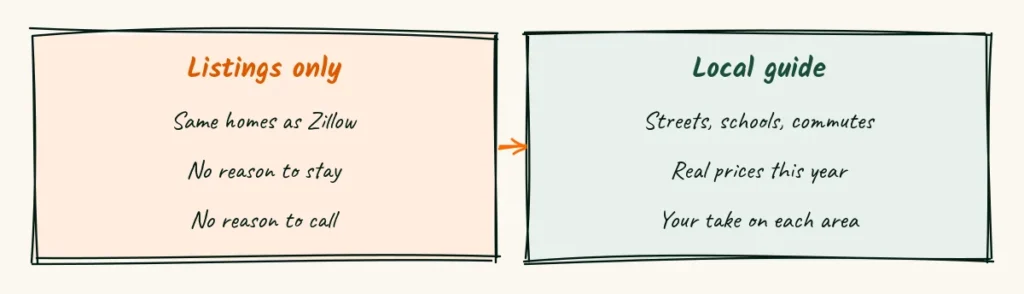
Lead with a person, then show the homes
Keep a listings page. Just don’t make it the first thing people see.
Your first screen should name the move, name the place and give one bit of proof.
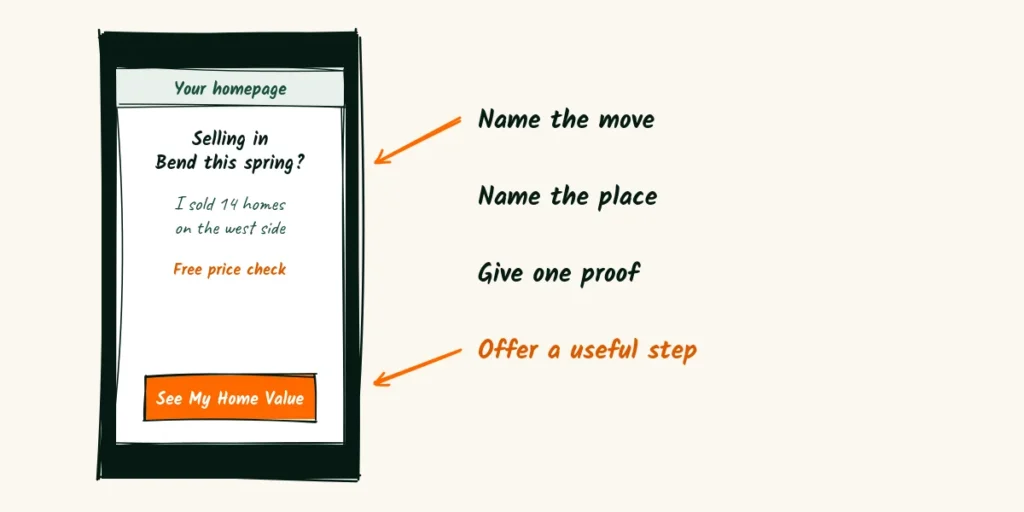
[Selling or buying] in [town or area] this [season]?
I [one proof, like a number of homes sold] in [neighborhood].
[One useful step, like a free price check].
[Button text]
A filled version might read like this. “Selling in Bend this spring? I sold 14 homes on the west side last year.
Get a free price check.”
Notice the button doesn’t say “Search homes.” It offers something a portal can’t give, a real person’s take on a real home.
“My brokerage page is enough”
Brokerage pages are fine for basics. They list your phone, email and license. Some even pull your listings automatically.
But they look like everyone else in the office. Same layout, same stock photos, same lines about “exceptional service.”
When a seller compares three agents from the same brokerage, those pages blur together.
Nobody gets remembered, so the choice falls back to price or chance.
What your own site can say that theirs can’t
Your own site, even a simple one, gives you room to sound like yourself. It can show the streets you know and the way you work.
Start with three short pages. Home, About and one page about the area you know best. You can grow from there, one page at a time.
Keep your brokerage name and license number clearly visible in the footer. Most states require it, and it adds trust too.
A domain that follows you
Agents change brokerages more often than they expect.
When that happens, a brokerage page usually disappears with every review and story on it.
A simple domain with your own name keeps that work safe. Your reviews, neighborhood pages and sold stories move with you.
Pick something short and easy to say on the phone. Your name, or your name plus your town, usually works best.
Avoid dashes and odd spellings, because people will mistype them.
“One page can talk to sellers and buyers”
Sellers and buyers are on opposite sides of the same deal. They want very different things, so one page never fits both.
A seller wants to know what their home is worth, how fast it will sell and what you’ll do.
A buyer wants to know what they can afford and which streets fit.

Build two doors from the homepage
Put two clear paths right under your first screen. One line each, one button each.
Thinking of selling? [See what your home could sell for]
Getting ready to buy? [Find streets that fit your budget]
Then give each path its own page. The seller page explains your plan, your marketing and your fee.
The buyer page explains the steps, the costs and who you work with.
Say your fee plainly
Fees changed in many markets in 2024. Sellers and buyers both have new questions about who pays what.
You don’t need to list a percentage if your broker prefers not to. But explain how you’re paid in one plain sentence.
Confusion here kills trust fast.
Answer the fee question before the call
Many sellers now ask about fees in the first minute. A short line on your seller page saves that awkward pause.
Here’s how I’m paid, what it covers and when it’s due. I’ll walk you through the numbers on our first call.
Calm, clear wording here makes you look confident. Vague wording makes people wonder what you’re hiding.
“A long bio builds trust”
It feels like more detail means more trust. So agents list every award, every designation and every year in the business.
Readers skim that. Titles like “Top Producer” and “Committed to Excellence” appear on thousands of agent sites.
They stop meaning anything.
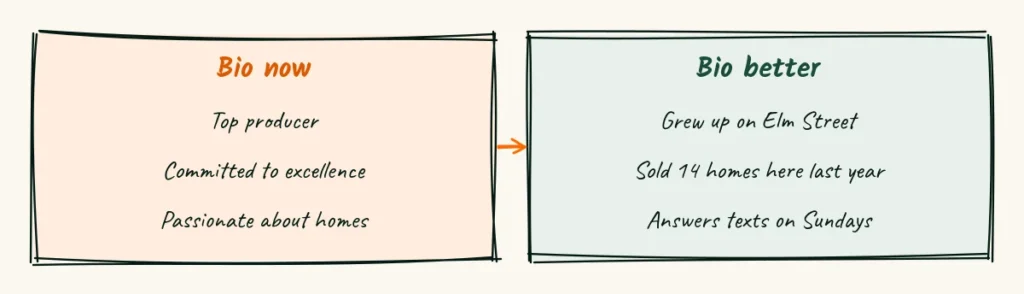
Three lines people remember
A good bio answers three things. Why you know this place, what you’ve done here and what you’re like to work with.
I grew up on [street] and still live [a few minutes] away.
Last year I helped [number] families buy or sell in [area].
I [one honest habit, like answering texts on Sundays or walking every home twice].
After those three lines, you can add your designations. Short and plain, in one line.
A photo that looks like you on a Tuesday
Skip the heavy studio retouching. Sellers will meet you at their front door.
If you look different, it’s a small jolt they’ll remember.
A clear, friendly photo taken outside in your area works well. A real street behind you says more than a gray backdrop.
Give sellers a page that answers the money questions
Sellers rarely say it first, but they’re thinking about money. What will I walk away with? What will this cost me?
How long will it take?
A seller page that answers those questions calmly makes you look prepared. It also saves you time on the first call.
What it costs to sell
List the main costs in plain words. You don’t need exact numbers for every case. Typical ranges are enough.
- Agent fees, explained in one honest sentence.
- Closing costs, with a typical range for your area.
- Repairs or touch-ups, if the home needs them.
- Moving costs and any overlap with a new home.
Add one line that calms the nerves. “On our first call, I’ll show you a rough net sheet so you know what to expect.”
How long it usually takes
Walk sellers through a simple timeline. Week one, getting ready. Week two, photos and listing. Then showings, offers and closing.
Use real numbers from your area. “Most homes in our town go under contract in about 3 weeks in spring, and closer to 6 weeks in winter.”
Honest timelines prevent angry calls later. A seller who expected six weeks won’t panic in week four.
Write a buyer page for first-timers
First-time buyers are nervous and often confused. Many don’t know where to start, and they’re afraid of asking a silly question.
A calm buyer page can win them early, sometimes months before they’re ready to make an offer.
The steps in plain order
List the steps in the order they really happen. Short lines, no jargon.
Talk to a lender and learn your budget.
Pick two or three areas to explore.
Tour homes together, then make an offer.
Inspection, appraisal and closing.
After the steps, add a line that invites questions. “No question is too basic. Most of my buyers had never done this before either.”
The people you’ll meet along the way
Buyers worry about the strangers in the process. Name the roles and say what each one does.
Lenders, inspectors, appraisers and title companies. One line each is enough.
If you have trusted names, offer a short list on request.
Make it easy to reach you
People contact agents in different ways. Some want to call. Many prefer to text, especially younger buyers. A few still like email.
Give them all three, clearly, on every page. Then tell them how fast you reply.
A contact line that sets expectations
One sentence near your button does a lot of work.
Text me any time at [number]. I reply within [time] on weekdays and by [time] on weekends.
Keep the contact form short. Name, phone, buying or selling, and a box for questions. Anything else can wait for the first chat.
Use the words people search for
People search the way they talk. “Homes near Riverside Park,” “best streets in Bend for walking,” “how much is my house worth in Bend.”
Use those phrases in your page titles and first lines.
Don’t stuff them in. Just make sure each page clearly says where it is and who it helps.
“Home value forms are spam”
Some agents avoid home value forms. They’ve seen tools that spit out a wild number, then flood the owner with calls.
Nobody wants to be that agent.
But a home value page answers the very first question most sellers have. Skipping it means missing your warmest leads.
The fix is to make the form honest, not to remove it.
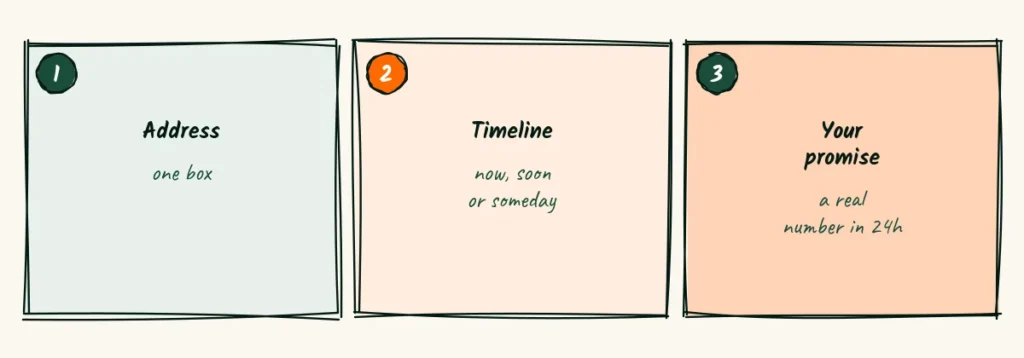
Make an honest promise
Ask only for the address and a rough timeline. Then promise what you’ll actually do.
I’ll look at recent sales near you and send a real price range within 24 hours. No automatic estimate, and no pushy calls.
Selling soon, in a year, or just curious? [Choose one]
That timeline question helps you too. A “just curious” owner gets a friendly note, not a sales call.
A “selling soon” owner gets a phone call the same day.
Real estate agent website pages that own your neighborhoods
Neighborhood pages sound like filler to many agents. A paragraph about parks, a few photos and a map.
Done well, they’re your strongest pages. People search for “living in [neighborhood]” long before they search for an agent.
A good page catches them early.
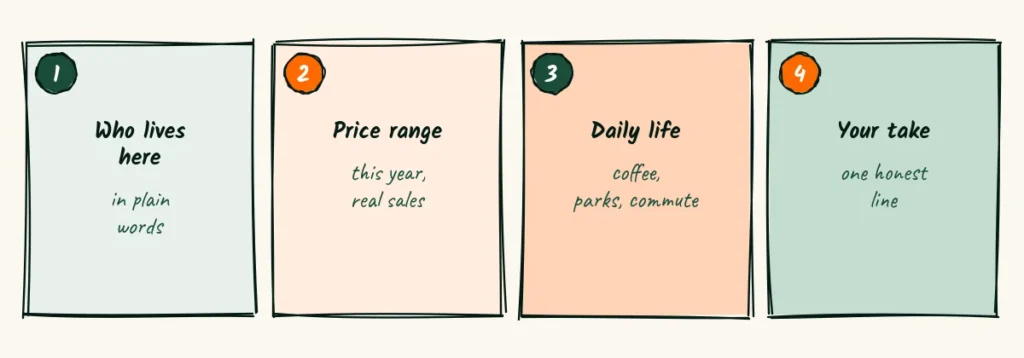
What goes on a neighborhood page
Each page needs four things. Who lives here, the real price range, what daily life feels like and your honest take.
Who lives here can be simple.
“Lots of retirees on the east end, more young couples near the trail.” Keep it about the place and the homes, not about who should buy.
Prices should come from real sales this year. “Most three-bedroom homes sold between $520,000 and $610,000 this year.”
Daily life is coffee, parks, the commute and noise.
“Trains pass twice at night, and you’ll hear them.” That kind of honesty is rare and valuable.
Your take, in one line
End each page with one line only you could write. “I’d buy here if you want a quiet street and don’t mind a longer drive to work.”
That line is what makes the page yours. It’s also what makes a reader trust you with the biggest purchase of their life.
“Any friendly wording is fine”
This is the myth that can cause real trouble. Friendly phrases about who a home suits can break fair housing rules.
The Fair Housing Act bans ads that show a preference based on race, color, religion or sex.
It also covers disability, family status and national origin.
The Department of Justice explains the law and how it’s enforced.
Your website counts as advertising. So do your listing descriptions and neighborhood pages.

Describe the home, not the buyer
The safe habit is simple. Describe the property and its features. Let buyers decide if it fits them.
| Risky | Safer |
|---|---|
| Perfect for young families | 3 bedrooms, fenced yard, near a park |
| Ideal for a bachelor | 1 bedroom, walk to restaurants |
| Great Christian neighborhood | Two blocks from a church |
| Not for wheelchairs | Second floor, no elevator |
If a phrase talks about who should live there, rewrite it to talk about what’s there. When unsure, ask your broker before you publish.
“Sold signs speak for themselves”
A sold sign in a yard is a quiet brag. Neighbors notice it for a week, then forget.
On your site, a sold home can work for years. But only if you tell its story. A grid of “SOLD” photos says almost nothing.
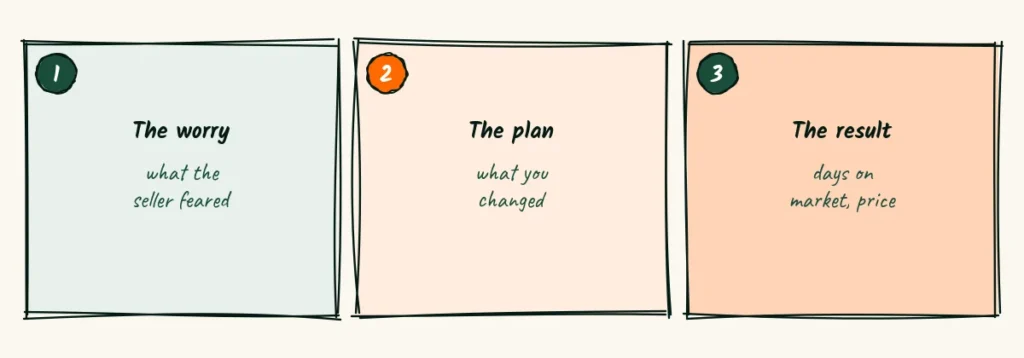
A sold story in three short parts
Every sold story follows the same simple shape. The worry, the plan and the result.
The worry. [What the seller feared, like the home sitting for months.]
The plan. [What you changed, like pricing, repairs or photos.]
The result. [Days on market and the final price compared to the asking price.]
Use first names only, and ask permission first. Many sellers are happy to be part of a good story.
Let reviews do the same job
When you ask for a review, ask a question that leads to a story. “What were you most worried about, and how did it go?”
Place the best reviews on matching pages. A downsizing story belongs on your seller page.
A first-time buyer story belongs on your buyer page.
“I can set it and forget it”
The market moves every month. Rates shift, prices change and seasons bring new buyers.
A site that never changes slowly starts telling small lies.
Old prices on neighborhood pages are the most common problem. So are “just listed” banners on homes that sold last year.
Keep a short update rhythm
You don’t need to rewrite everything. A light rhythm keeps the site fresh without eating your weekends.
- Monthly. Check your homepage proof line and your newest listings.
- Every three months. Update price ranges on neighborhood pages.
- Every season. Swap your first-screen line to match the season.
- Every year. Reread your About page and your fee explanation.
Put these in your calendar now. Treat them like a listing appointment, because they bring in future listings.
Each update takes less than an hour once you get used to it. Many agents do theirs on a slow Monday morning with a coffee.
Track what brings calls
Ask every new client one simple question. “How did you first find me?” Write the answer in your client notes.
After six months, patterns appear. Maybe one neighborhood page brings most sellers. Maybe your home value page brings nothing.
Write more of what works, and fix or remove what doesn’t.
A small site that pulls its weight beats a big site full of pages nobody reads.
If your site tool shows page views, compare them with your notes.
A page with lots of visits and no calls usually needs a clearer next step, not more words.
Reuse what you already make
You probably make videos, flyers and social posts already. Your site can share that work so you’re not writing twice.
If you’ve recorded a real estate agent introduction video, place it on your About page.
It does the trust work while you’re out showing homes.
The same goes for print. A real estate agent flyer can point to one neighborhood page with a short link or a QR code.
Test your site the way a stranger would
You know your site too well to judge it. So borrow fresh eyes before you call any change finished.
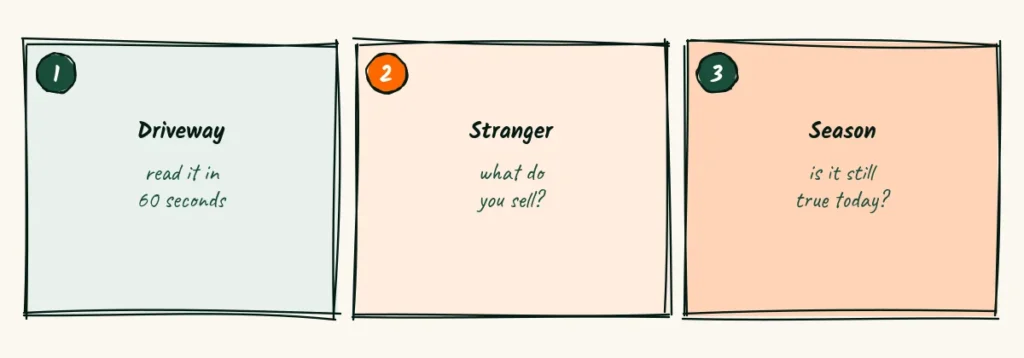
The driveway test
Sit in your car outside a listing and open your site on your phone. Give yourself 60 seconds.
Can you see who you help, where, and what to do next? If not, your first screen needs work.
The stranger test
Ask someone outside real estate to read your homepage. Then ask what you sell and why they’d pick you.
If they say “houses” and shrug, your proof line isn’t strong enough. Add a number, a place or a promise.
The season test
Read every page and ask one question. Is this still true today?
Fix anything that isn’t. Old facts cost more trust than missing ones. For more page ideas, browse the website copy category.
Two agents, one search, one call
Picture two agents in the same town. Both have a real estate agent website.
One opens with listings and “Your dream home awaits.” The other names the street, the season and a free price check.
The second agent gets the late-night call. That’s the opportunity.
Most agents still run brokerage templates, so plain local words stand out quickly.
The threat is real too. Portals keep getting better at showing homes, and AI tools can write generic bios in seconds.
Generic is getting cheaper every month.
Your edge is what nobody else can copy. Your streets, your sales and your honest take.
So this week, rewrite your first screen and build one neighborhood page.
Then check every line for fair housing wording before you publish.
Frequently Asked Questions
How often should an agent add blog posts to their website?
Once or twice a month is plenty if each post answers a real local question, like a school change or a new road project.
How many neighborhood pages should a new agent write?
Start with the two or three areas you know best. One strong page beats ten thin ones that repeat the same lines.
Can I use photos from the MLS on my website?
Only within your MLS and broker rules. Many limit how long listing photos can stay up after a home sells, so check first.
Should I post market updates on my website or social media?
Both. Put the full update on your site so it lasts and can be found in search, then share a short version on social.
Is it worth adding a chat box to an agent website?
It can help if you answer quickly. A chat that sits unanswered for hours feels worse than a simple text-me button.

Read next
Math Tutor Website Copy, Graded Like a Report Card in 8 Subjects
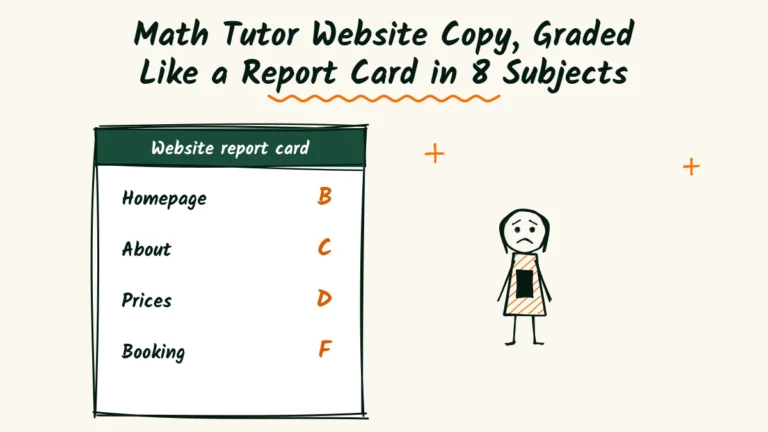
Grade your tutoring site like a report card. 8 subjects, from the first screen to safety lines, with a clear fix for every low...
Read NowInterior Designer Website Copy, Written Like a Design Brief in 7 Sections
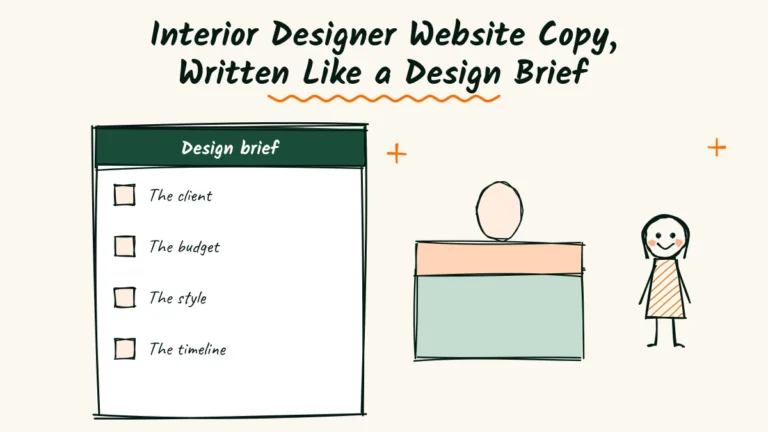
Clients hire from a brief, not a gallery. Write your site in 7 sections, from the client and the problem to budget and next step.
Read NowA Wedding Planner Website Run Like the Big Day, in 9 Time Slots

Run your website like a wedding day. 9 time slots, from the first hello to the inquiry send-off, with words couples trust.
Read Now