

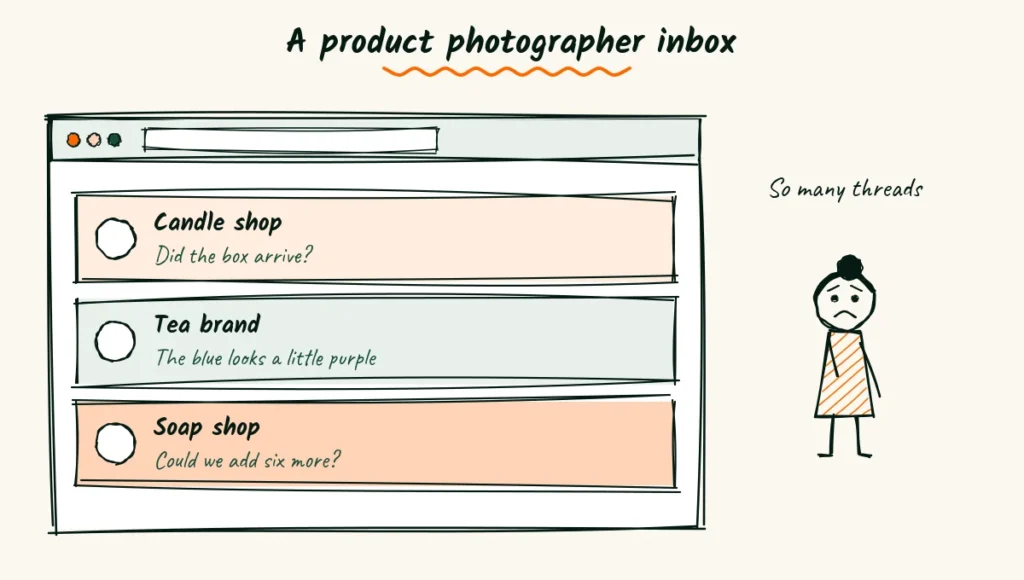
Did the box arrive?
The blue looks a little purple on my screen.
Could we squeeze in six more products?
If you shoot products for online sellers, your inbox probably holds messages a lot like these.
Each one is a chance for a good product photographer client email to calm things down.
Most of those threads start because the seller can’t see what you see.
Their products are in your studio, and they’re at home, refreshing the tracking page.
The right email closes that gap before it turns into worry.
It says what happened, what happens next and what the seller needs to do, in a few short lines.
Below are ten of those emails, in the order a shoot usually unfolds.
They start with the box leaving the seller’s door and end with a friendly note three months after the photos go live.
Why product shoots need a few extra emails
Portrait clients come to you. Product clients send you their stock, and then they wait.
That wait is where nerves grow. The seller has handed over things they made or paid for.
They can’t see your table, your lights or your care. All they can see is your email.
There’s another twist. Product photos go to many places at once. Listings, ads, a website banner, a wholesale catalog.
So the seller needs clear notes on which file goes where, or the best photo ends up cropped badly on the wrong page.
That’s why the emails below lean on three habits.
- Say what you did, with a photo when you can.
- Say what happens next, with a day or a date.
- Ask for one thing at a time, never a list of five.
Good small business emails follow the same three habits, whatever the trade.
Before the box ships, send a packing guide
The first email after booking sets the tone for the whole job. Keep it warm, short and practical.
Most sellers have never shipped products to a photographer before.
They worry about breakage, about forgetting something and about how they’ll get it all back.
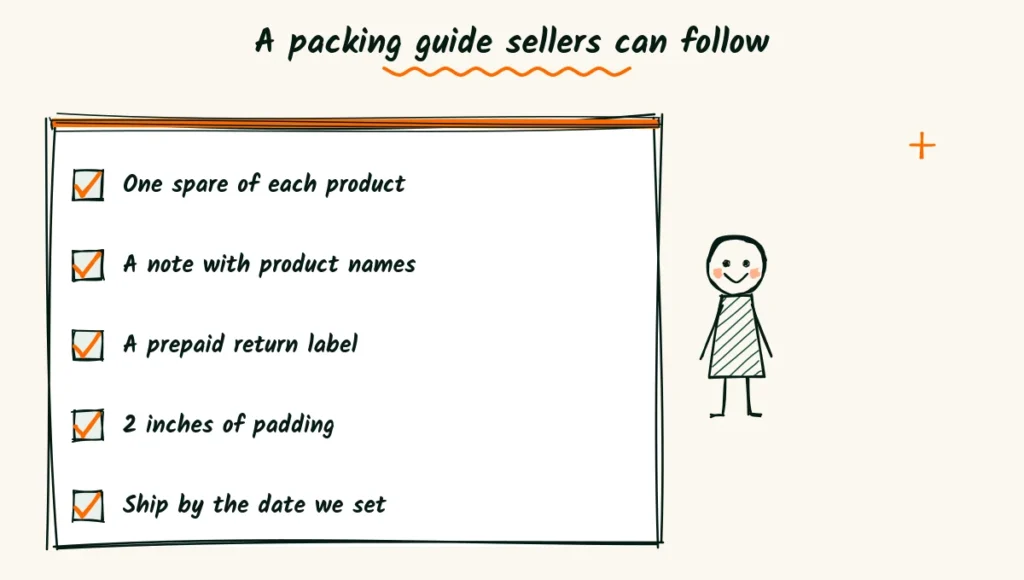
Hi [name], thanks for booking! I can’t wait to see your [product type].
Here’s a simple packing guide so everything arrives safely.
Please send [number] of each item, plus one spare if it’s fragile.
Add a note with the product names, so I match the right photo to the right listing.
Include a prepaid return label, or tell me if you’d like me to arrange one.
Ship by [date] so we stay on track for your [launch / listing] date.
Packing advice helps here too.
UPS suggests at least two inches of cushioning around light items. Pass that tip on to sellers shipping glass, candles or ceramics.
A one-page packing guide as a PDF saves you from typing it again. Attach it to this email every time.
Tell them the box arrived, and what was inside
The moment the parcel lands, send a short note. This one email stops more worried messages than any other.
Unpack carefully and check every item against the seller’s note. Then snap a quick photo of everything laid out on your table.
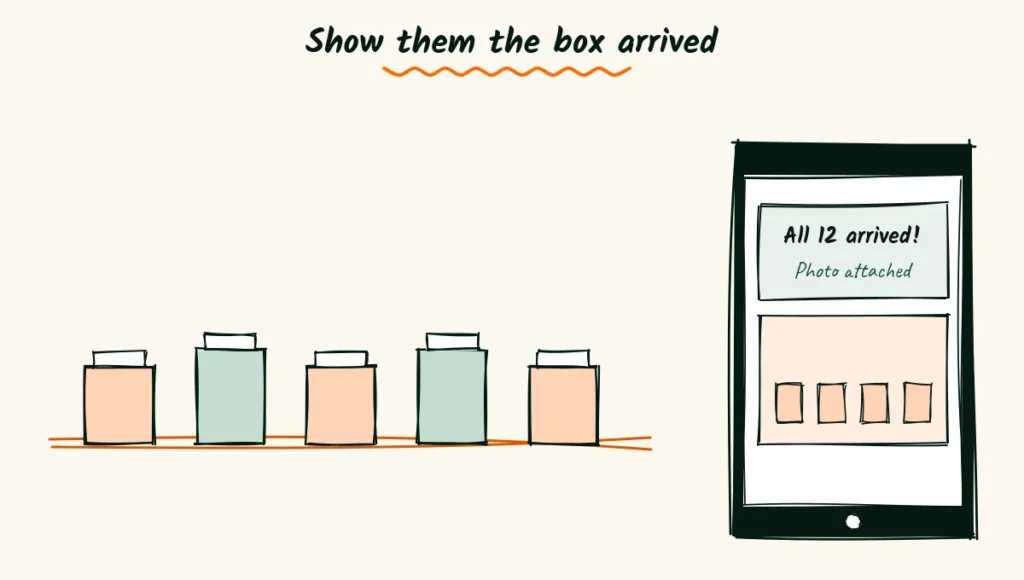
Hi [name], good news. Your box arrived safely this morning.
I counted [number] items, and they match your list. Photo attached.
Your shoot is set for [day]. You’ll get a sneak peek that afternoon.
A photo of the products lined up says “I’ve got them, and I’m taking care of them” better than any sentence could.
If the count doesn’t match, say so in this same email.
“Your list shows 12 mugs, but I found 11” is much easier to sort out today than after the shoot.
What if something arrives broken?
Breakage happens, even with good packing. The way you report it matters more than the damage itself.
Stay calm, stick to facts and offer a choice. The seller should never feel blamed.
Hi [name], I’m sorry to say one item arrived damaged. The lid on the [product] cracked in transit. Photos attached.
The box looked dented on one corner, so it likely happened on the way.
I can still shoot the rest on [day].
For this one, would you like to send a replacement, or should I shoot it from the angle where the crack doesn’t show?
Keep the damaged item and its packing until the seller says what to do. They may need photos for a shipping claim.
It helps to say in your booking terms who covers items damaged in the post.
Most photographers ask sellers to insure valuable parcels themselves, which keeps this email simple and blame-free.
Never hide a crack with editing without asking. A shopper who receives a different item will leave the kind of review nobody wants.
Confirm the shot list before the lights go on
Product shoots go wrong when the seller and the photographer picture different photos. One quick email before shoot day fixes that.
Send the shot list as a short table, so the seller can scan it in a minute.
| Product | Shots | Where they’ll be used |
|---|---|---|
| Amber candle | Main on white, lid off, in a hand | Etsy listing |
| Sage candle | Main on white, scene on a shelf | Etsy listing, Instagram |
| Gift set | Group shot, box open | Website banner, holiday ad |
Hi [name], here’s the plan for [day]. Could you check it and reply with a quick yes, or any changes?
If I don’t hear back by [time], I’ll go with this list.
That last line keeps the shoot moving. Many sellers are busy, and a gentle deadline helps them reply.
Invite them to send two or three reference photos they love, from any brand.
A picture of a style they admire answers questions that would take ten emails to explain in words.
You’ll also spot early if their taste and your style don’t match.
Send one sneak peek on shoot day
A single preview photo on shoot day does wonders.
The seller relaxes, gets excited and often shares it with friends before the gallery is even ready.
Pick the strongest photo, give it a quick edit and send it with two or three lines.
Hi [name], a little sneak peek from today. Your amber candle looks gorgeous on white.
The full gallery will be ready by [day]. More soon!
One photo is enough.
Five previews start a conversation about each one, and you’ll spend the evening answering questions instead of editing.
This is also a good moment to ask about sharing.
A line like “Mind if I share this one on my Instagram once your listing is live?” gets a yes far more often than a request months later.

Delivery day, with a map of the files
The gallery email is the big one.
It’s also where many sellers get lost, because they open a folder full of files with no idea which goes where.
So send a simple map along with the link.
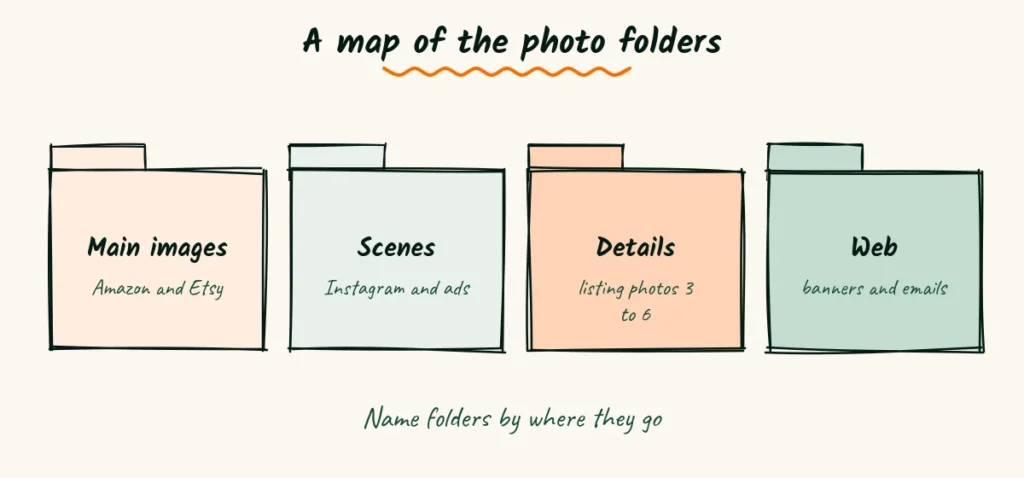
| Folder | What’s inside | Best for |
|---|---|---|
| Main images | Square, pure white | Amazon and Etsy main photos |
| Scenes | Styled shots | Instagram, website, ads |
| Details | Close-ups, textures | Listing photos 3 to 6 |
| Web | Wide crops | Website banners and emails |
Hi [name], your photos are ready! Here’s the link to your gallery. [link]
I’ve sorted them into four folders so you know where each one goes. A quick map is below.
Please download them within [number] days, as the link expires after that.
If anything looks off, just reply to this email and I’ll take a look.
Naming the folders by use, not by shot type, saves the seller real time.
“Main images” is clearer than “White background, square crop, high-res.”
Two days before the link expires, send a one-line reminder. Sellers often open the gallery, love it and forget to download.
A short nudge saves a panicked email a month later.
The product photographer client email that settles color worries
Sooner or later, a seller writes, “The blue looks purple on my screen.”
It’s the most common worry in product work, and often the photo is fine.
Screens show colors differently. A phone on night mode, an old laptop or a bright monitor can all shift the shade.
Still, take every color note seriously.
Hi [name], thanks for flagging this. Color matters a lot for your shoppers, so let’s get it right.
Could you hold the real product next to your screen, near a window in daylight, and tell me how it compares?
I’ve also checked it on my calibrated screen, where it matches the product I photographed.
If it still looks off to you, I’ll adjust it and send a new version by [day].
This email does three things. It thanks them, it gives them a simple check and it promises action without arguing.
If the color truly is off, fix it quickly and say so plainly. “You were right, the blue was a touch warm.
Here’s the corrected file.” Sellers trust photographers who admit small slips.

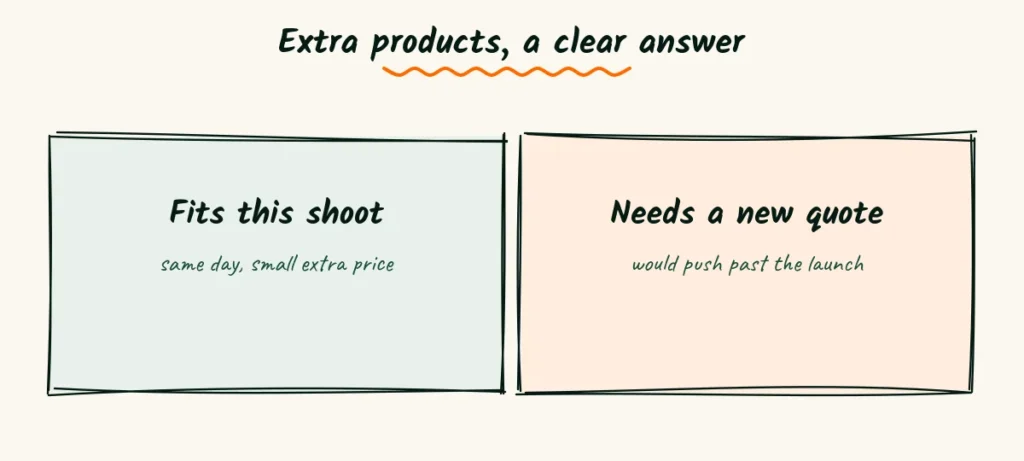
Could we add six more products?
Scope creep is friendly in product work. Sellers aren’t trying to take advantage. They just found more stock in the back room.
Answer with a yes and a number, so the money talk feels easy.
Hi [name], happy to help with those! Six more products would be [price], and I can shoot them on [day].
If you’d like to keep the budget the same, we could swap out [number] of the current products instead.
Just let me know which way you’d like to go.
Giving two choices keeps you from sounding pushy. The seller picks, and you both stay happy.
Sometimes the honest answer is “not this week.”
If extra products would push the delivery past their launch, say so and offer a second short shoot instead.
A rushed gallery helps nobody.
The box is on its way home
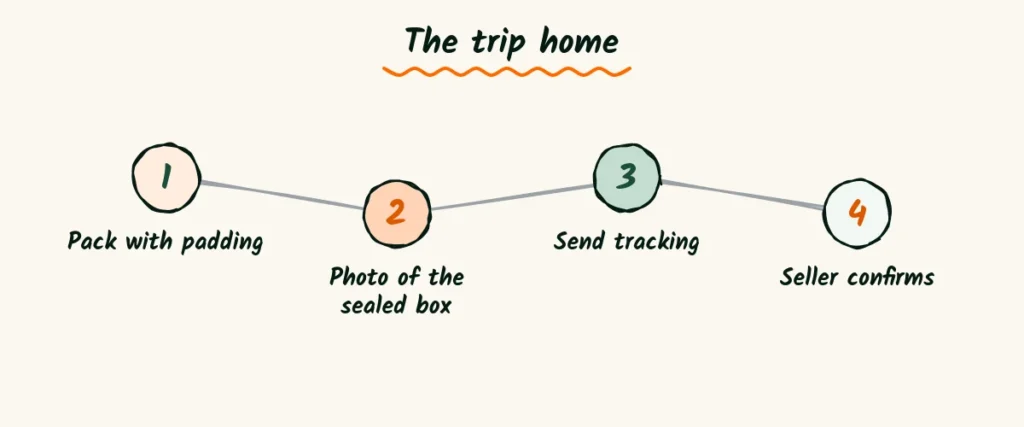
Products going back is the last physical step, and sellers worry about it as much as the first.
Hi [name], your products are packed and on their way back to you today.
Tracking number is [number]. I used the same box and extra padding.
Please check everything when it arrives and let me know it all made it home.
Take a quick photo of the packed box before you seal it. If something goes missing in transit, you’ll both be glad you did.
Three months later, a friendly check-in
Most photographers stop at delivery. A short note a few months later is where repeat work and reviews come from.
Hi [name], just checking in. How are the new photos working for your shop?
If you’ve noticed any changes in views or sales, I’d love to hear about it.
And if you have new products coming up, I’d be glad to shoot them too.
Keep it light. No discount codes, no long pitch. Many sellers reply with good news, and some reply with a new box of products.
If they share a result, ask whether you can mention it on your website. Real numbers from real shops help other sellers trust you.
A short client story like that is also one of the easiest blog posts for product photographers to write.
Subject lines that get opened in a busy inbox
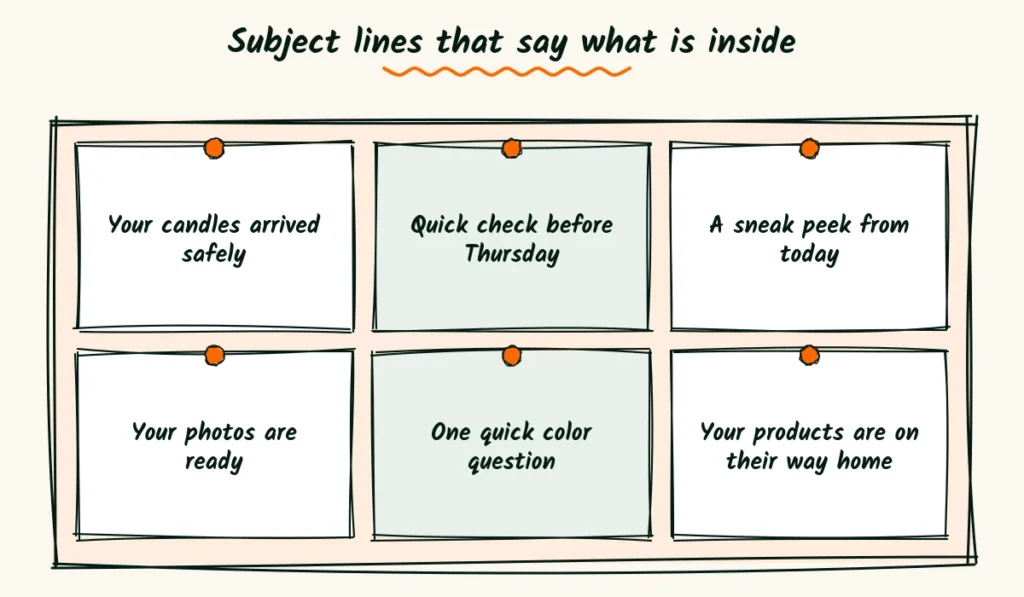
Online sellers get a flood of email from platforms, buyers and suppliers. Your subject line needs to say exactly what’s inside.
- Your candles arrived safely
- Quick check before Thursday’s shoot
- A sneak peek from today
- Your photos are ready, with a file map
- One quick color question
- Your products are on their way home
Notice that each one tells the seller what the email is about and whether they need to do anything.
No “Update” or “Following up,” which say nothing at all.
When a seller goes quiet
Sometimes the inbox goes silent. The seller doesn’t confirm the shot list, or the gallery sits unopened for a week.
Silence rarely means a problem. Usually the seller is packing orders, traveling or simply buried in email.
A short, kind note brings most of them back.
Hi [name], just bumping this to the top of your inbox. No rush, I only need a quick yes or no on [one thing].
If it’s easier, reply with one word and I’ll take it from there.
Asking for one small action makes replying easy. A seller who has to read a long email again will put it off a second time.
If two nudges get no answer, go with the plan you shared and note it in your tracker. You’ve been clear, and the work keeps moving.
A gentler start for first-time sellers
Some clients have never hired a photographer of any kind.
They may not know what a shot list is, or why you need product names in the box.
For these sellers, add one extra email right after booking that walks through the whole job in plain steps.
- You ship the products to me.
- I let you know they arrived, with a photo.
- We agree on the shots.
- I shoot and send you a sneak peek.
- You get your photos, sorted by where they go.
- Your products come home.
That short list turns a mystery into a plan. First-time sellers often say it’s the reason they felt safe booking at all.
Words to swap in client emails
Photographers sometimes slip into studio words that leave sellers confused. Plain words keep emails short and friendly.
| Instead of | Try |
|---|---|
| Deliverables | Your photos |
| Post-production | Editing |
| Color grading | Adjusting the colors |
| Usage license | Where you can use the photos |
| Per the contract | As we agreed |
Read each template out loud once.
If it sounds like a form letter, warm it up with the seller’s name and one detail about their products.
Set up your emails once, use them for years
Writing the same email twenty times a month eats hours. Saving templates takes one afternoon and pays back every week.
Save them where you write
Most email apps let you save reusable replies.
In Gmail they’re called templates, and other apps call them canned responses or snippets.
Save each of the ten emails above with a clear name, like “02 Box arrived” or “06 Gallery ready.” The numbers keep them in shoot order.
When it’s time to send one, open the template, fill in the brackets and add one personal line. It takes about a minute.
Keep a simple client tracker
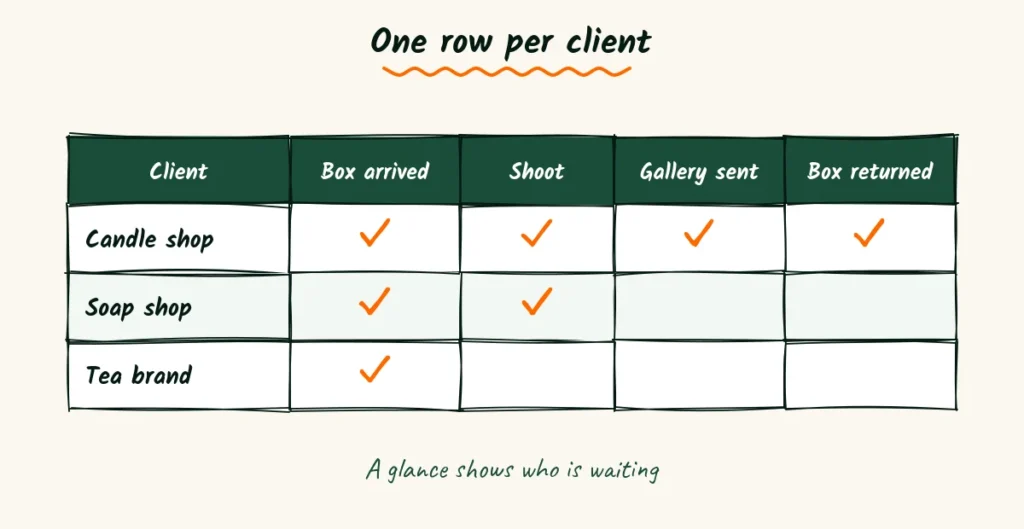
A plain spreadsheet with one row per client is plenty. Add columns for “Box arrived,” “Shoot,” “Gallery sent” and “Box returned.”
Tick each column when you send that email.
A glance shows which clients are waiting on you, so nobody slips through the cracks during a busy week.
Write the next email before you need it
When you send one email, schedule or draft the next one.
If you send the gallery on Monday, set a reminder for the three-month check-in right away.
Future you will be grateful, and the seller will think you have a whole team behind you.
The same habit keeps client emails for brand photographers on track, even with bigger teams on the other side.
Usage rights, said kindly
Product photos often travel further than sellers expect.
A listing photo ends up in a paid ad, a wholesale catalog or on a retailer’s site.
That’s why usage needs a short, friendly line in your emails.
Say what’s included, up front
Put the basics in your booking email, in plain words.
For example, “These photos are yours to use on your own shop, website and social media.”
Most small sellers only need that. Saying it early means they won’t worry about it later.
Explain what costs extra, before it comes up
Some uses, like large ad campaigns or a retailer’s catalog, may come with an added fee in your pricing.
Mention that gently in the same email.
If you’d like to use these photos in paid ads or give them to a store that sells your products, just let me know first.
I’ll send a simple quote for that use.
Clear terms early stop awkward talks later. They also make you look like a pro who has done this many times.
Put it in writing, once
Whatever you agree, keep it in one place.
A short paragraph in your booking email or agreement is easy to point to if questions come up a year later.
Late payments without the awkwardness
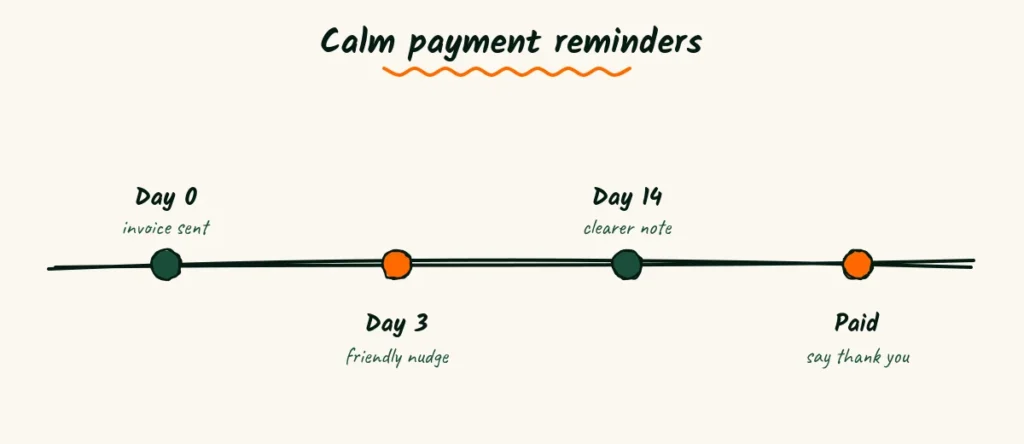
Most sellers pay on time. When one doesn’t, a calm, steady set of reminders works far better than one stern email.
A friendly nudge after three days
Small sellers juggle a lot of bills. A short reminder often fixes things in minutes.
Hi [name], a quick reminder that invoice [number] for your product photos was due on [date]. Here’s the link to pay. [link]
Let me know if you have any questions.
A clearer note after two weeks
If there’s still no reply, stay polite but be specific about what happens next.
Hi [name], I haven’t seen payment for invoice [number] yet. Could you let me know when to expect it?
Your gallery link will pause on [date] until the invoice is settled.
Never threaten or add guilt. A plain note with a date is enough, and it keeps the door open for future work.
The next email is already on its way
Product sellers will keep writing to you whether you plan for it or not.
The real choice is whether your product photographer client email lands first with answers, or late, inside a worried thread.
The risk of waiting is easy to miss.
Every unanswered “Did the box arrive?” chips away at a seller’s trust.
And trust is what brings a client back with the next product line.
The upside is just as real. Few photographers send arrival photos, file maps or three-month check-ins.
Those small notes make you memorable in a crowded market.
Pick the three emails you send most and turn them into templates this week. It takes one quiet hour, and it pays back on every shoot.
Add the rest as each shoot comes along.
Frequently Asked Questions
Should I send these emails or texts?
Email works best for files, links and anything with a date. A quick text is fine for the arrival photo if the seller prefers it.
How fast should I reply to a new inquiry?
Within one working day is a good aim. Even a short “I’ll reply in full tomorrow” note keeps the seller from moving on.
Do I need a contract as well as emails?
Yes. Emails explain the steps, but a short written agreement covers payment, usage and what happens if products are lost.
What if a seller never sends a return label?
Ask once in the arrival email and again before the shoot. If it still doesn’t come, quote the return shipping and add it to the invoice.
Should I CC the seller’s assistant or partner?
Only if the seller asks. Ask who should get gallery and invoice emails during booking, and save it in your tracker.

Read next
8 Brand Photographer Client Emails, From First Reply to Six Months On

Owners scan email for a date, a cost and a job. These 8 short emails cover a whole brand project, ready to copy.
Read NowClient Emails for Personal Branding Photographers, Hello to Gallery Day

Short, kind emails take a client from first hello to gallery day. Copy the drafts, subject lines and follow-ups.
Read Now11 Headshot Photography Client Email Templates, From First Hello to Gallery

Think of each booking as a short trip. Eleven calm emails take a client from first hello to new photo, gate by gate.
Read Now