
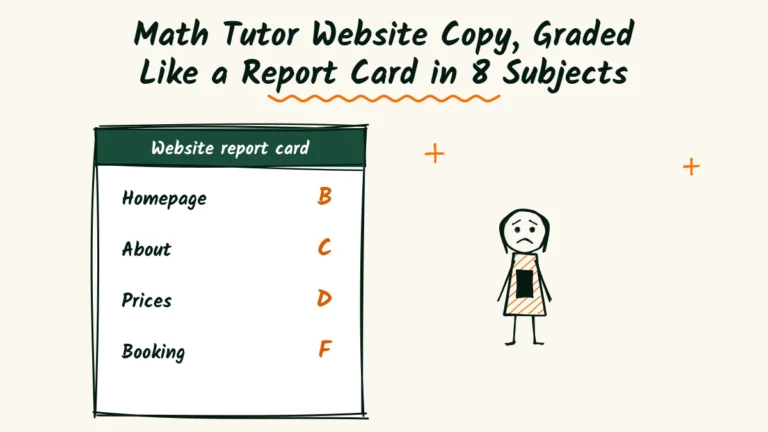
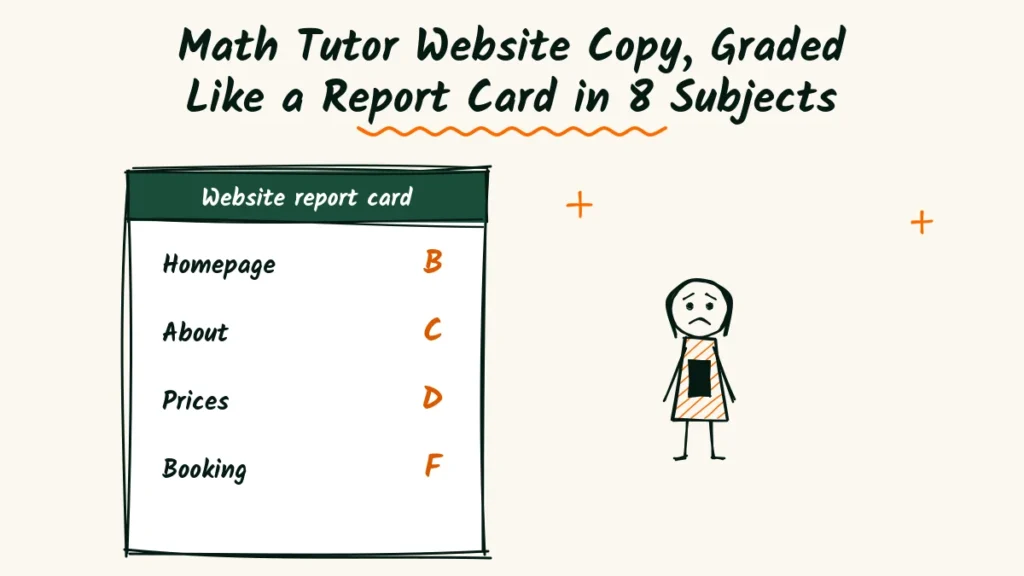
C minus. Circled twice in red, with “see me” written underneath.
That test paper sits on a kitchen table tonight. A parent is staring at it, then at their phone, typing “math tutor near me.”
What they find in the next two minutes decides who gets the call. Your math tutor website either calms that parent or loses them.
Most tutor sites lose them quietly. They list degrees, say “all levels welcome” and hide the price somewhere deep inside.
So let’s grade your site the way a teacher grades a student.
Eight subjects, one honest grade each, and a clear fix for every low mark.
You’ll get fill-in lines, a short booking form, price layouts and three tests you can run at your own kitchen table.
Grade your site before a parent does
Open your site on your phone. Then score each part below from A to F. Be strict. Parents will be.
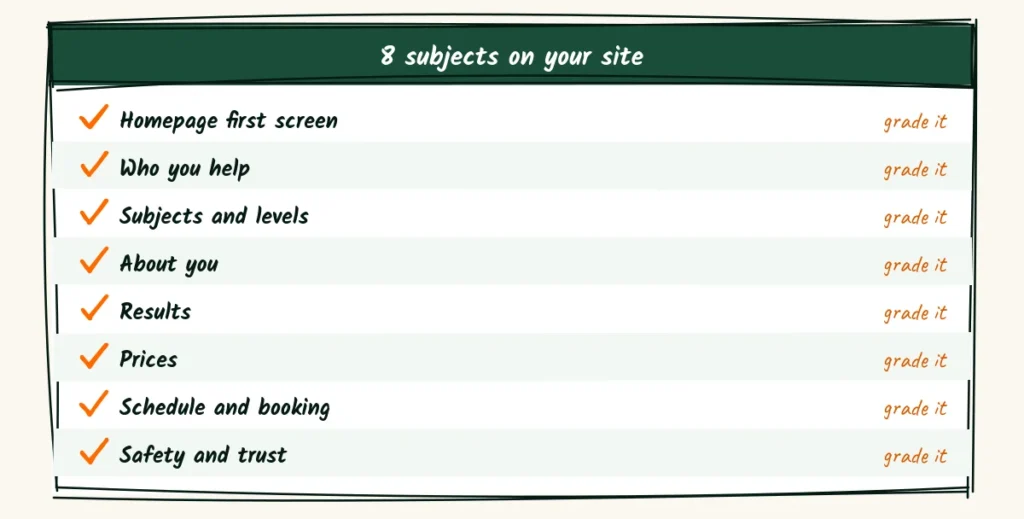
| Subject | An A looks like | An F looks like |
|---|---|---|
| First screen | Names the class and grade | “Welcome to my page” |
| Who you help | One clear type of student | “All ages, all levels” |
| Subjects | Listed by grade band | One long list of topics |
| About you | A short, warm story | A list of degrees |
| Results | Real changes, with numbers | “Students improve” |
| Prices | Shown in plain numbers | “Contact for rates” |
| Booking | Four boxes and a button | A two-page form |
| Safety | Background check and rules | Nothing at all |
Write your grades on a sticky slip of paper or in your notes app. Then work from the lowest grade up. That’s where parents leave.
The first screen has one job
A worried parent reads the top of the page and decides in seconds. If it doesn’t match their child’s problem, they’re gone.
Your first screen should name the class, name the grade and say where you teach. Then offer one easy next step.
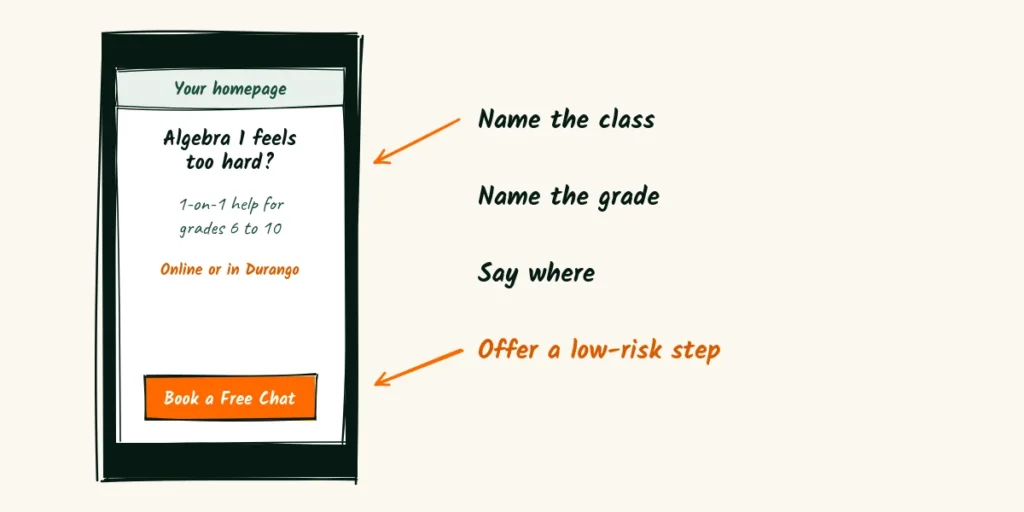
[Class name] feels too hard?
One-on-one help for grades [range], at your pace.
Online or in [town].
[Book a free 15-minute chat]
A filled version could say this. “Algebra 1 feels too hard? One-on-one help for grades 6 to 10, at your pace. Online or in Durango.”
The free chat matters. Parents don’t want to buy a package from a stranger. A short call feels safe and costs them nothing.
Swap the vague line for a real one
Many tutors open with lines that sound nice but say nothing. Here’s how to trade them in.
| Present | Better |
|---|---|
| Unlock your child’s potential | Fractions finally making sense |
| Excellence in education | Help with tonight’s homework |
| All subjects, all levels | Math for grades 6 to 10 |
Who are you really helping?
A tutor site talks to more than one reader. The parent pays. The student has to show up.
Some families homeschool and need a full plan.
Each reader wants something a little different, so it helps to know who you’re talking to on each page.
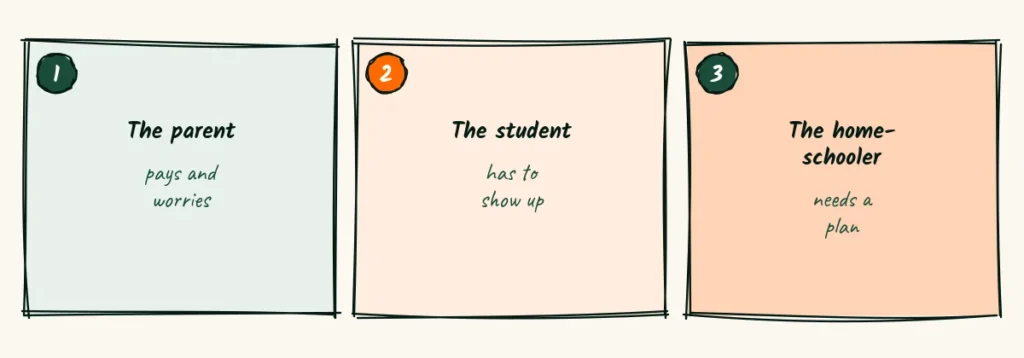
The parent wants to know if you’re safe, skilled and worth the money. Write most of your pages for them.
The student wants to know you won’t make them feel stupid.
Give them one line, maybe on your About page. “No question is too basic here.”
Homeschool families want a plan for the whole year. If you serve them, give them their own short page with a sample week.
Pick a lane you can own
“All ages” sounds generous, but it feels like nobody in particular. A narrow promise is easier to trust.
Try finishing this line for yourself. “I help [type of student] who struggle with [topic] get to [result].”
If you can’t pick one lane yet, pick the one you enjoy most. Your site can grow into others later.
List subjects the way parents search
Parents rarely type “quadratic functions tutor.” They type the class name or the grade. “7th grade math tutor.” “Geometry help.”
So list your subjects by grade band first, then add topics inside each band.
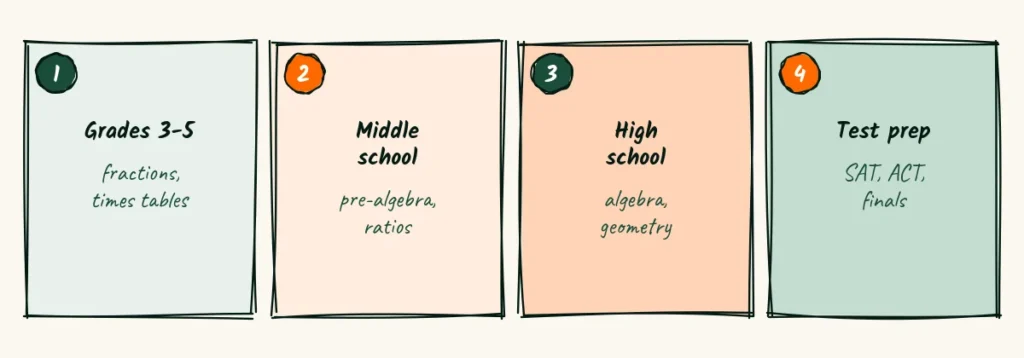
Each band can become its own short page later. Start with a simple list on one page.
- Grades 3 to 5. Times tables, fractions, word problems.
- Middle school. Pre-algebra, ratios, negative numbers.
- High school. Algebra 1 and 2, geometry, pre-calculus.
- Test prep. SAT, ACT, state tests and final exams.
Use the exact class names schools use near you. If the local high school calls it “Integrated Math 1,” write that too.
Math tutor website pages that earn trust
Trust is the whole sale for a tutor. Parents are inviting you into their child’s week, and often into their home.
Three pages do most of the heavy lifting here. Your About page, your results and your safety lines.
An About page that tells a short story
Degrees matter, but they belong lower down. Lead with a small, true story about why you teach math.
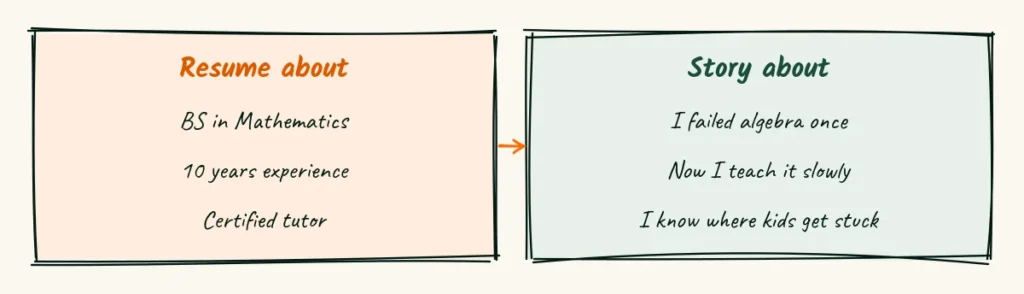
I’m [name], and I [your honest link to struggling with math, or watching someone struggle].
Now I teach [subject] to [type of student], one step at a time.
I know the spot where most students get stuck. It’s usually [specific spot].
Outside tutoring, I [one human detail].
Admitting you once struggled is powerful. It tells the student you get it, and it tells the parent you’re patient.
Results parents can picture
“Students improve” is easy to write and easy to ignore. A clear result paints a picture a parent can hold onto.
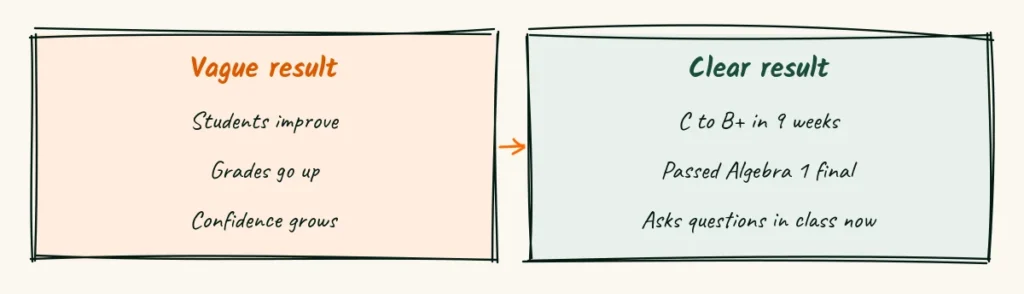
Ask families for permission, then share small, real changes. Use first names only, or just the grade.
“[Student first name] went from a [grade] to a [grade] in [weeks]. Now [small change in behavior].” [Parent first name], [town]
Not every win is a grade. “She asks questions in class now” can move a parent more than a letter on a report card.
Safety lines a parent looks for
Parents rarely ask about safety out loud. But they look for it, and they leave when they can’t find it.
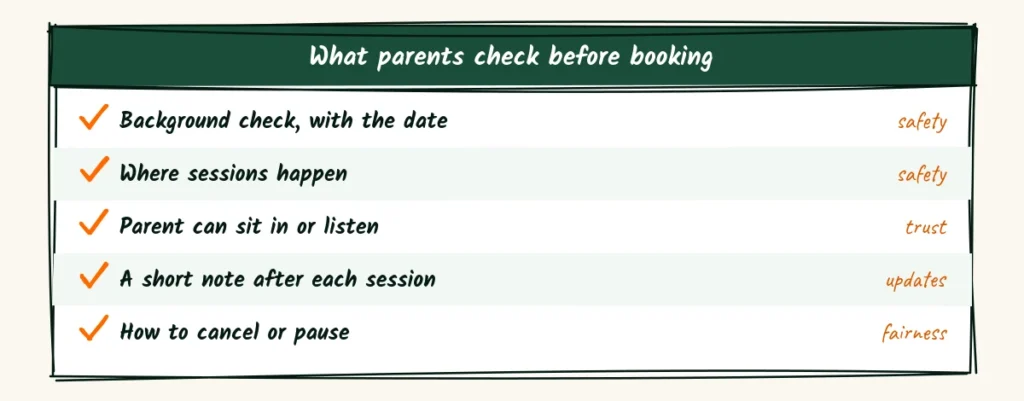
Write these lines in plain words on your About page or your booking page.
- My background check was completed in [month, year].
- Sessions happen [online, at your home, at the library].
- You’re welcome to sit in or listen any time.
- I send a short note after every session.
Mention how online sessions work
If you tutor online, describe the setup in one or two lines. “We use a shared whiteboard and a simple video link.
No downloads needed.”
Parents worry that tech trouble will eat into paid time.
Offer a free five-minute test call before the first session, and that worry disappears.
Show prices in plain numbers
“Contact me for rates” makes parents nervous. Many will assume you’re too expensive and never ask.
Three simple options usually cover most families. Keep the names plain so nobody has to guess.
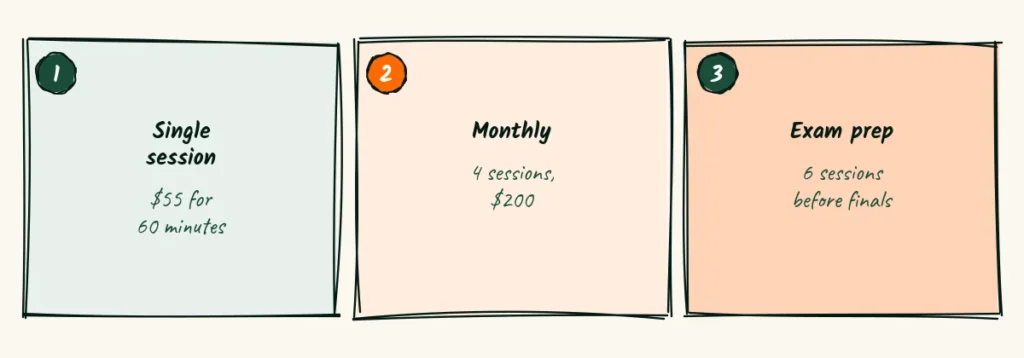
| Option | What’s included | Price |
|---|---|---|
| Single session | 60 minutes, one topic | $55 |
| Monthly plan | 4 sessions, notes after each | $200 |
| Exam prep pack | 6 sessions before finals | $300 |
Under the prices, add one line about cancellations. “Cancel up to 24 hours ahead and you won’t be charged.”
Answer the money question kindly
Some parents will worry about cost even after seeing it. A gentle line helps without sounding salesy.
Not sure how many sessions you’ll need? Most students need [number] to [number] to catch up on one topic.
We’ll plan it together on the free call.
Walk parents through a real session
Many parents have never hired a tutor. They don’t know what an hour looks like, so they picture something stiff and boring.
A short walk-through clears that up. It also shows you have a plan, which is exactly what a worried parent wants.
The first session
The first meeting sets the tone. Describe it in a few calm steps, so nobody walks in nervous.
We start with a short chat about what feels hard and what your child already likes.
Then we try a few easy problems together, so I can see where things get stuck.
At the end, I send you a short plan with the next three topics.
Notice there’s no test. Many students dread being tested by a stranger. Saying “no quiz on day one” can win over a nervous teen.
A regular session
Regular sessions follow a simple rhythm. Spell it out so parents know where their money goes.
- 10 minutes on homework or questions from class.
- 35 minutes on the main topic, with practice.
- 10 minutes on a quick review and a small win.
- 5 minutes to set a tiny goal for the week.
That small win at the end matters. Students leave feeling capable, and parents hear about it at dinner.
Answer the worries parents don’t say out loud
Some questions feel awkward to ask on a first call. Parents still think them, and they still decide based on them.
Answer a few of them on your site. It shows you understand families, not just math.
“What if my child doesn’t click with you?”
Write a kind line about fit. “If it doesn’t feel right after two sessions, tell me. I’ll help you find someone better suited.”
This sounds risky, but it builds trust. Parents relax when they know they aren’t trapped.
“Will you just do the homework for them?”
Many parents worry about this. Say how you handle homework in one or two lines.
I help with homework by asking questions, not giving answers. Your child does the work. I make sure they understand why it works.
“How will I know it’s working?”
Tell parents what they’ll see and when. “After each session, you’ll get a short text. Every four weeks, I send a quick progress note.”
Regular updates are often the reason families stay for a whole year.
Give homeschool families their own page
Homeschool parents shop differently. They often want a full plan, a set schedule and help choosing materials.
A short, separate page speaks to them directly instead of burying them in a page written for school kids.
What to include for homeschoolers
Keep it practical and specific. A few lines cover what most families ask first.
- Which curriculum you know well, by name.
- How you track progress across a full year.
- A sample week with days and topics.
- Whether siblings can share a session.
Add one line about pace.
“We can move faster in topics your child loves and slower where they need it.” Homeschool parents value that freedom.
Trade teacher words for parent words
Tutors often write like teachers. That’s natural, but parents don’t always speak that language.
A quick swap makes your pages feel friendlier without dumbing anything down.
| Teacher words | Parent words |
|---|---|
| Differentiated instruction | Lessons that fit your child |
| Remediation | Catching up |
| Formative assessment | A quick check to see what’s sticking |
| Scaffolding | Breaking it into small steps |
| Learning objectives | What we’ll work on |
Read one of your pages out loud. Each time a word sounds like a school report, swap it for one you’d use with a neighbor.
Make booking feel like a quick text
A long sign-up form scares busy parents. They have work, dinner and three other kids to think about.
Ask only what you need to call them back. Everything else can wait for the free chat.
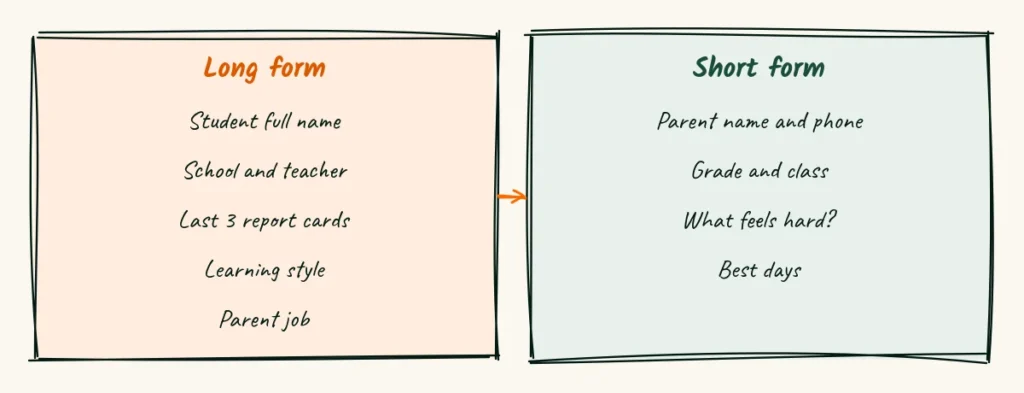
A four-box form is enough. Parent name and phone, grade and class, what feels hard, and the best days for sessions.
The button matters too. “Submit” sounds like homework. “Book my free chat” sounds like help.
What happens after they hit send
Tell them right away what comes next. It stops the worry and the second-guessing.
Thanks, [parent name]. I’ll text you by [time] to set up a free 15-minute chat. Bring the latest test or homework if you have it.
That last line is a small gift. It shows you’ll look at the real problem, not just sell a package.
Write one page for the panic weeks
Tutoring has busy seasons. The weeks before finals, the first report card and the end of summer all bring a rush of worried parents.
A short page for each rush can catch those searches and those feelings.
Before finals
Title it with the class and the season. “Algebra 1 final exam help in Durango.”
List what you’ll cover, how many sessions you suggest and when spots fill up. Then add one booking button.
After the first report card
This is when parents first notice a problem. Your page can sound calm and hopeful.
A low grade in October isn’t the end of the year. It’s a signal. Most students who start now are caught up by [month].
Summer catch-up
Summer pages work well for parents who want a fresh start. Offer a short four-week plan before school begins.
You can share the same seasonal message in a printed math tutor flyer at the library or the school office.
Add a face and a voice
Parents want to see who will sit with their child. One friendly photo near the top of your About page helps a lot.
A short video helps even more.
Thirty to sixty seconds of you explaining one tiny math idea shows your patience better than any line of text.
If you’ve recorded a math tutor introduction video, place it on your About page and on the booking page.
What to say in a short clip
Keep it simple and warm. Say your name, the classes you help with and one small promise.
Then solve one tiny problem on paper, out loud, slowly. Show the step where most students get confused, and fix it with a smile.
End with one line that invites the parent in. “If this looks like your child’s homework, book a free chat and bring it along.”
Record it twice and keep the more relaxed take. Parents care more about your patience than your polish.
Post the clip near the top of your About page, and add a written version under it for parents who watch with the sound off.
Keep the photo real
Skip the stock image of a smiling teacher at a whiteboard. A plain photo of you at a table with a notebook is better.
Good light and a calm face are all you need. Your phone camera is fine.
Speak to search the way a parent types
You don’t need to be an SEO expert to get found. You just need to use the same words parents use when they search.
Use your town and your classes
Put your town in your page titles and in one line of your homepage. “Math tutor in Durango for grades 6 to 10.”
Name each class on its own page over time. “Geometry tutor in Durango” can bring in a very different parent than “SAT math prep.”
Answer real questions on the page
Write down the questions parents ask on your first calls. “How often should we meet?” “Do you help with homework or only tests?”
Answer each one in two or three lines on the matching page. Those answers help both parents and search engines.
Run three tests before you call it done
You know your site too well to judge it fairly. So borrow some fresh eyes and a weak phone signal.
These three tests take less than half an hour and catch most of the problems that cost you calls.
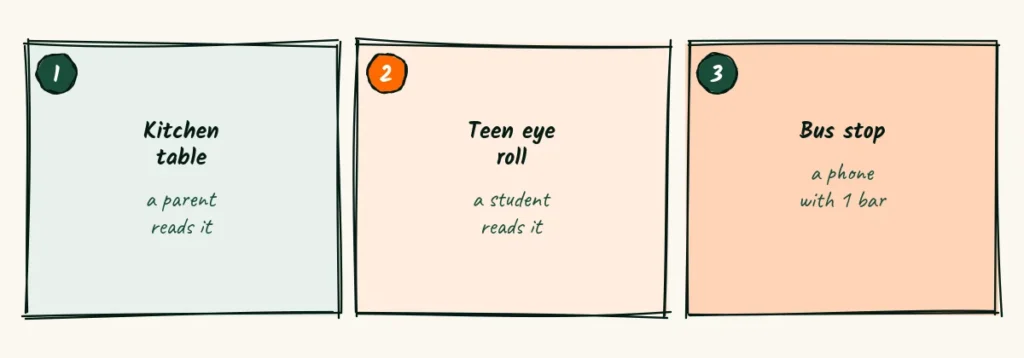
The kitchen table test
Ask a parent you know to read your homepage on their phone. Then ask them three questions. What do you teach, where, and how much?
If they can’t answer all three in under a minute, rewrite the first screen and the price section.
The teen eye roll test
Show your About page to a teenager. If they roll their eyes, your tone is too stiff or too cheesy.
Ask them which line sounds most like a real person. Keep that line. Rewrite the others to match it.
The bus stop test
Open your site on a phone with one bar of signal. Time how long it takes to see your headline and your button.
If it’s slow, ask whoever built your site to shrink large photos. Parents often search while waiting somewhere.
Keep the site honest as you grow
Your site should change as your tutoring changes. New prices, new classes and new results all deserve a quick update.
National scores shift from year to year, and the Nation’s Report Card shows how students across the country are doing in math.
Your page should speak to what local families face now.
Update results each term
At the end of each term, ask two families for a short update. Swap one old result for a new one.
Fresh results tell parents you’re active and still getting wins, not coasting on old stories.
Check every price and date
Old prices and outdated dates cause awkward calls. Put a reminder in your calendar to check them every three months.
If you raise your rates, change the site first. Then tell current families in person or by text.
Watch which pages bring calls
Ask every new family how they found you. Write it down. After a term, you’ll know which pages are doing the work.
Write more pages like the ones that bring calls. You’ll find more ideas in my website copy guides.
Your site is the first lesson
A math tutor website is often a parent’s first lesson from you, long before the first session.
If it’s clear, patient and honest, they assume you teach the same way.
That’s a real opening, because most tutor sites still hide prices and lead with degrees.
The risk is that parents judge fast and rarely come back.
A vague first screen or a scary form can lose a family for the whole school year.
So pick your lowest grade from the report card and fix that one first. For most tutors, it’s prices or booking.
Then rewrite your first screen to name the class, the grade and the town. Run the kitchen table test this week.
One honest page at a time, your site starts doing the calm talking for you.
Frequently Asked Questions
Should a math tutor list rates if they change for each student?
Yes, show a starting price or a range. You can explain on the free call why some students need a different plan.
Do I need a separate site for online tutoring?
No. One site works. Just say clearly on each page whether sessions are online, in person or both.
Is it okay to share student grades on my website?
Only with the parent’s written permission, and use first names or initials. Many tutors share the grade change without any name.
How many pages should a new tutor site have?
Start with five. Home, About, Subjects, Prices and Booking. Add seasonal and class pages once those are working.
Should students or parents fill in the booking form?
Parents, in most cases. They pay, plan the schedule and need to agree to the rules, so write the form for them.

Read next
9 Real Estate Agent Website Myths That Keep Sellers From Calling
Listings won't sell you, and a long bio won't either. 9 website myths agents believe, with plain words to use instead.
Read NowInterior Designer Website Copy, Written Like a Design Brief in 7 Sections

Clients hire from a brief, not a gallery. Write your site in 7 sections, from the client and the problem to budget and next step.
Read NowA Wedding Planner Website Run Like the Big Day, in 9 Time Slots

Run your website like a wedding day. 9 time slots, from the first hello to the inquiry send-off, with words couples trust.
Read Now