

Most of these case studies come from emails my readers send me. With their permission, I share them with the names changed. I do this so that others can learn from what worked and what didn't. Have a story of your own? Share it with me.
- 3 to 8steady clients
- 40 to 15 mindiscovery calls
- 22 to 3services listed

Twenty-two minutes into the call, the owner still hadn’t said what she wanted help with.
Wilhelmina Kerr had asked three times, kindly.
The owner finally laughed and said, “Honestly, I was hoping you’d tell me.”
That moment shaped this virtual assistant services example.
Wilhelmina, an assistant in Rapid City, South Dakota, rewrote her services page over two months.
She went from three steady clients to eight. Her discovery calls got shorter, and far more of them ended in a booking.
The problem
Wilhelmina had good skills and happy clients. Her page just didn’t help new owners understand what working with her would look like.
On calls, three reactions kept coming up.
They couldn’t choose
Her page listed 22 services, from email management to travel booking to podcast editing. Owners read the list and froze.
They expected her to pick for them. That turned every call into a long, tiring interview.
By the end, Wilhelmina had usually suggested a plan out loud.
But owners couldn’t see it written anywhere, so they left the call unsure what they’d actually agreed to.
They feared the passwords
Almost every owner asked how access would work. Some asked twice.
The page said nothing about it, so the worry sat there until the call. A few owners never booked a call at all.
One told her later that she’d read the whole page twice looking for the word password.
When she didn’t find it, she assumed the answer would be uncomfortable.
They wanted a number
She charged by the hour, with no price on the page. Owners imagined a bill growing every time they sent her a message.
Several said they’d “think about it” once they heard her rate, and she never heard from them again.
The solution
Wilhelmina didn’t add services. She cut them down and made the hand-off easy to picture.
She focused on the clients she liked most, real estate agents juggling listings and client updates.
A virtual assistant services example for real estate agents
Her new page opens with one line. “Admin support for real estate agents who’d rather be at showings.”
Below it, she listed three hand-offs only. Listing paperwork prep, client update emails, and calendar and showing schedules.
Each one says what she takes, what the agent keeps and how she reports back.
For client updates, for example, she sends a weekly email to each buyer or seller from a saved template.
The agent keeps every pricing talk and every hard conversation.
She also added a short first week plan, so agents could see exactly when the first job would be off their desk.
Three hour blocks
She replaced hourly billing with three monthly blocks of 10, 20 and 30 hours, each with a starting price.
Under the blocks, one sentence explained unused hours. A few roll over for one month, then they reset.
An access promise
She added a short section on access.
Her own login wherever possible, a password manager for shared accounts and two-step sign-in everywhere.
She ended it with one line agents loved. “You own every account. I can be removed in one click.”
The process that worked
Wilhelmina didn’t guess what to write. She went back through three things she’d kept for years.
Her call notes
She read through notes from 40 discovery calls. The same three tasks came up again and again with agents.
Those became her three hand-offs. Everything else moved to a short line at the bottom saying she could discuss other work.
Her time logs
Her time tracker showed how long each kind of task really took. Client update emails for one agent averaged about six hours a month.
That helped her size the blocks honestly. The smallest one covered a single hand-off with a little room to spare.
Her old invoices
She looked at what her best clients actually paid each month. Most landed between $400 and $800.
She set her blocks around those numbers, so new owners would see prices close to what happy clients already paid.
Then she tested the page on two agents she knew but had never worked with.
Both picked the same hand-off first, client updates, without any prompting.
One asked whether she’d ever see the agent’s commission checks.
Wilhelmina added a line saying she never handles banking, and that question stopped coming up on calls.
She also read a government guide on strong passwords before writing her access section.
It helped her explain password managers in plain words.
What we learned from here
This virtual assistant services example shows how a shorter menu can win more clients than a long one.
Within two months, Wilhelmina’s roster went from three steady clients to eight.
About half of her discovery calls now end in a booked block, up from roughly one in six.
Calls also got shorter, from about 40 minutes to 15.
Agents arrived knowing which hand-off they wanted, so the call was about details, not discovery.
Here’s what turned into a booked block and what turned into a polite maybe.
| Turned into a booked block | Turned into a polite maybe |
|---|---|
| Three named hand-offs for agents | A list of 22 services |
| Monthly blocks with prices | Hourly rates with no total |
| A clear access promise | Silence about passwords |
| What the owner keeps, in writing | “I can help with anything” |
| Prices close to real client spend | Prices set by guesswork |
| A line about unused hours | Surprise rules on the invoice |
A few lessons travel well beyond virtual assistance.
A long menu hands the hard work back to the buyer. When Wilhelmina chose for them, owners relaxed.
Your own records know your prices. Call notes, time logs and invoices told her more than any pricing article.
Trust sits in the boring details. The access section was the plainest part of the page and the one agents mentioned most.
Narrow doesn’t mean small. Focusing on agents filled her calendar faster than offering everything to everyone ever did.
Wilhelmina now adds a short client quote to the page every few months.
She’s also thinking about a second page for small property managers.
For the full method, including the hand-off note and first week plan, see this guide to describing virtual assistant services.
More case studies
Personal Branding Photographer Thea Cut 7 Packages to 3

- 7 to 3packages on her page
- 1 in 4 to 3 in 5calls that became bookings
- 11 to 2pricing emails a month
Clear Session Names Take Portrait Photographer Imani From 5 to 17 Bookings a Month

- 5 to 17sessions booked a month
- $210 to $305average booking
- 9 to 1what-is-included emails
Brand Photographer Isolde Moved Her Packages Out of a PDF and Tripled Her Bookings

- 2 to 6bookings in four months
- 4 to 3packages became services
- 0license mix-ups since
One Rewritten Page Nearly Doubles Bookings for Maternity Photographer Ines

- 20% to 37%of inquiries booked
- 5 to 2emails before booking
- 2 of 5now choose the middle package
Bronze, Silver and Gold Out, 4 Clear Plans In for Headshot Photographer Celeste

- 22% to 61%of inquiries booked
- 15 to 2what's included emails a month
- 3Team Days booked
Real Estate Agent Silas Moved His Face Off the Postcard, Booked 2 Listings a Month

- 1 a quarter to 2 a monthlisting appointments
- 15texts per mailing
- 1,200homes mailed
Real Estate Agent Augustin Rewrote His Site in a 3-Day Snowstorm and Got 6 Seller Leads a Month
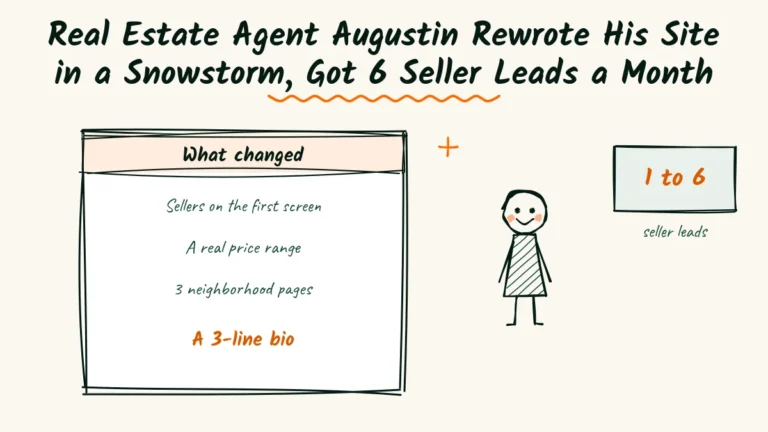
- 1 to 6seller leads a month
- 9price check requests in 2 months
- 5pages rewritten, no redesign
Personal Trainer Teodoro Moved His Flyer to Rehab Clinics and Got 9 Calls a Month

- 1 to 9calls a month
- 6new regular clients
- 21 to 8words in the headline