
Most of these case studies come from emails my readers send me. With their permission, I share them with the names changed. I do this so that others can learn from what worked and what didn't. Have a story of your own? Share it with me.
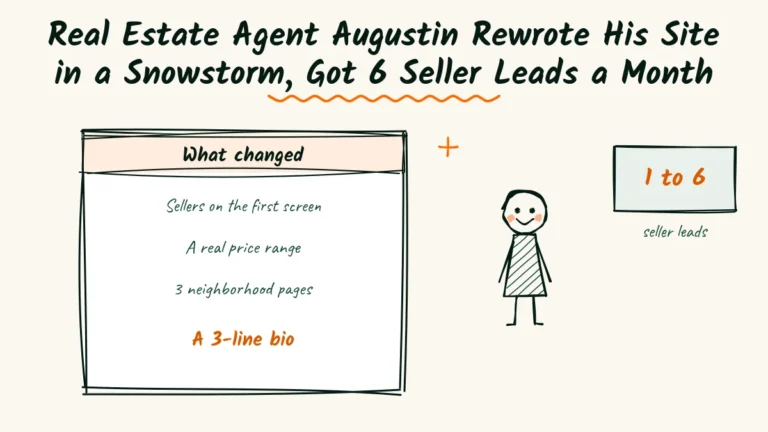
- 1 to 6seller leads a month
- 9price check requests in 2 months
- 5pages rewritten, no redesign
Snow closed the pass for three days in January.
Augustin Brennan spent them at his kitchen table, building a real estate agent website example he now shares with newer agents.
Augustin sells homes in Sandpoint, Idaho, a lake town with a busy summer and a quiet winter. His site had been live for four years.
It looked polished, but almost no sellers contacted him through it.
Buyers browsed his listings, then booked tours through the big portals.
After that snowed-in rewrite, seller leads from the site rose from about one a month to six.
The problem
Augustin’s site came from a template his brokerage recommended. It worked, in a technical sense.
Pages loaded, listings updated and forms sent emails.
But it didn’t sound like anyone in particular. Three things made sellers drift away before they ever reached out.
Every visitor saw the same grid
The homepage opened with a large search bar and a grid of twelve listings. Under it sat the line “Find your dream home today.”
Sellers had no reason to stay. Nothing on the first screen spoke to someone wondering what their own house was worth.
The bio started in 2004
His About page opened with the year he got his license, then listed designations and awards. It ran close to 600 words.
The parts people cared about were buried near the end. He’d grown up on the lake, and he still coached kids’ ski racing every winter.
The value form promised too much
His home value page offered an “instant estimate.” It pulled a number from a data tool, and that number was often far off.
Two sellers called him upset that the figure didn’t match his later advice. A few others never replied after seeing a low number.
The solution
Augustin decided his site should feel like meeting him at the coffee shop on First Avenue. Friendly, local and specific.
He kept the template’s design but changed almost every word on five pages.
The real estate agent website example sellers see first
The new first screen reads “Selling near the lake this year? I sold 11 homes in Sandpoint last year.
Get a real price range in 24 hours.”
Under it sit two short paths. One for sellers and one for buyers, each with its own button and its own page.
An honest price check
He replaced the instant estimate with a simple form.
It asks for the address and a timeline, then promises a real range from Augustin within 24 hours.
He added one line under the button. “No automatic numbers, and no pushy calls. Just my honest read on recent sales near you.”
Pages for the places people search
Augustin wrote three neighborhood pages for the lake side, downtown and the north end.
Each one covers who lives there, real prices and daily life.
Every page ends with his own short take. On the north end page, it says the drive is longer, but the views are worth it.
The process that worked
With the roads closed and showings cancelled, Augustin had unusual free time. He split the work across the three snowed-in days.
Each day had one focus, and he finished each page before moving on.
The first snowed-in morning
He started by reading his old homepage out loud.
His teenage daughter listened from the couch and said it sounded like a car commercial.
He rewrote the first screen until she could repeat it back in her own words. It took six tries.
The second day, still no plows
Augustin pulled his sales from the past year and grouped them by area.
Those numbers became the price ranges on his neighborhood pages.
He also checked every line against fair housing rules.
A phrase about homes being great for retirees became a line about single-level floor plans.
The third day, roads still closed
On the last day, he rewrote his About page down to three short lines and a photo.
He grew up on the lake, sold 11 homes there last year and coaches ski racing in winter.
He then asked three past clients for short stories about their sales.
Two replied that evening, and their stories went onto his seller page.
What we learned from here
Other agents often ask Augustin for a real estate agent website example to borrow.
His advice is to lead with the place and the seller, not the listings.
Sellers stayed longer on his new pages and read further. More importantly, they reached out with real questions about their homes.
Honest beats instant
The new price check form brought in nine requests in the first two months. The old instant estimate had brought in about one a month.
Sellers liked that a real person looked at their home. Several said the promise of no pushy calls made them feel safe to ask.
Local pages pulled in early sellers
The neighborhood pages drew people who were months away from selling. Some read them, left and came back in spring.
Two of those early readers listed with Augustin in May. Both mentioned the lake side page on their first call.
| Brought sellers in | Kept sellers away |
|---|---|
| A first screen about selling near the lake | A search bar and “Find your dream home” |
| A real price range within 24 hours | An instant estimate that missed |
| Three short neighborhood pages | One page of listings for every area |
| A three-line bio with a photo | A 600-word list of awards |
| Past clients’ stories on the seller page | A wall of “Sold” photos |
Augustin also learned that his best details were the small human ones.
People remembered the ski coaching long after they forgot his designations.
He now updates his neighborhood price ranges each quarter.
Market numbers move, and stale prices would quickly undo the trust he built.
Plain, current information matters for buyers too.
The Consumer Financial Protection Bureau’s guide to buying a home shows how much people value clear, honest steps.
For agents stuck at a desk on a slow day, the same three-day plan works.
Rewrite the first screen, write one real estate agent website page about the area you know best, then shorten the bio.
Augustin’s next project is a short page for buyers moving from out of state.
Many of his summer calls come from people who have never seen the town in winter.
More case studies
Esthetician Annelise Renamed 1 Facial and Got 17 Online Bookings a Month

- 6 to 17online bookings a month
- 14 to 8services on the menu
- 3rewritten claims per page
Tamsin Changes 6 Menu Words and Gets 13 Inquiries a Month as a Maternity Photographer

- 5 to 13inquiries a month
- 3 to 8in 10 forms completed
- 9 to 21maternity sessions in a quarter
Math Tutor Odessa Moved Her Prices to the Homepage and Got 10 Inquiries a Month
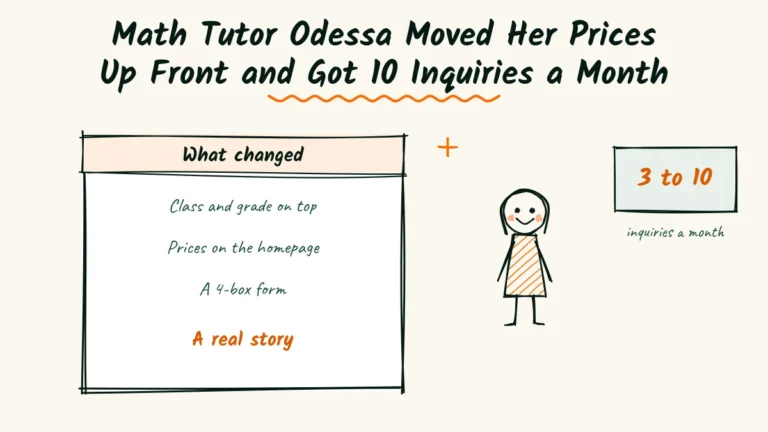
- 3 to 10new inquiries a month
- 11 to 4boxes on the booking form
- 4 pagesrewritten, no redesign
Interior Designer Ingeborg Dropped a 12-Step Style Quiz and Got 8 Inquiries a Month
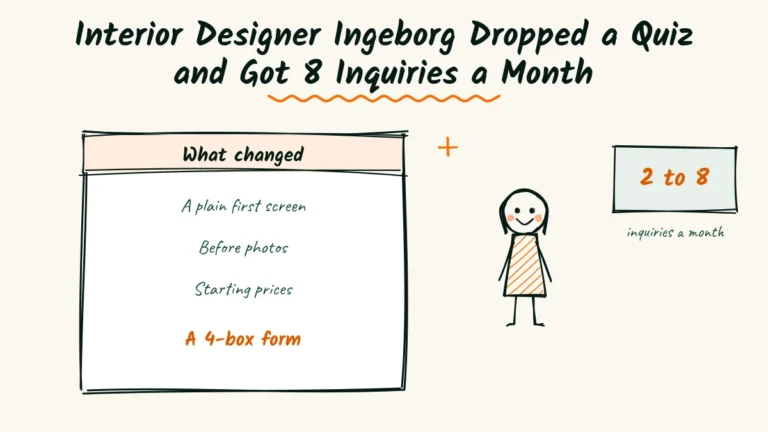
- 2 to 8inquiries a month
- 12 to 4steps before saying hello
- 6project stories with before photos
Personal Branding Photographer Laurel Cut Her Website to 7 Pages

- 2 to 9inquiries a month
- 11 to 7pages on her site
- 9 to 3fields in her form
Gone in 9 Seconds. Headshot Photographer Bianca Rebuilds and Gets 15 Inquiries a Month

- 4 to 15form inquiries a month
- 6s to 2shomepage load on a phone
- 11 to 5form fields
Brand Photographer Bertrand Fixed 3 Hot Spots on His Website and Got 11 Messages a Month

- 3 to 11form messages a month
- 5shoots booked
- 14 to 5form fields
Noor’s Portrait Photographer Website Goes From 1 Message a Month to 11 With Plainer Words

- 1 to 11messages a month
- 6 to 190visits to the sessions page
- 6sessions booked