
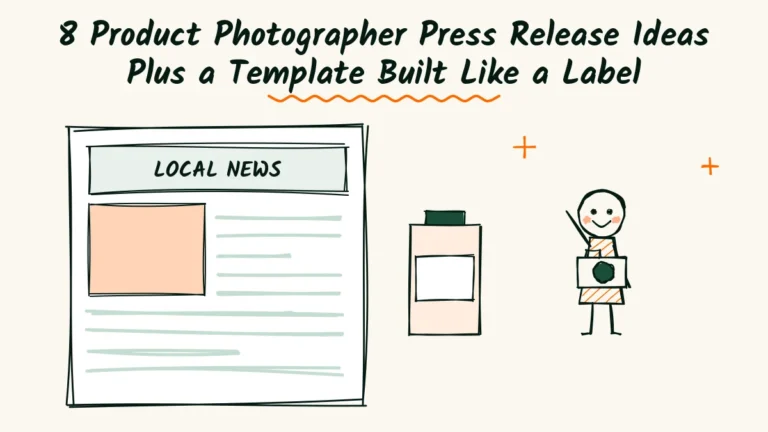

City council approves new bike lanes.
High school band heads to the state finals.
Local tea blender now ships to 40 countries from a garage.
Look at that third headline. A product photographer press release can start right there, with a small seller and a big story.
Somebody had to take the photos that made those 40 countries click “buy.” That somebody could be you.
Local editors love stories about makers, shops and people building something from a spare room. You work with those people every week.
You also know how to turn a product into a picture, which is half of what a newsroom needs.
The trick is giving editors a story they can use, not an ad they have to delete.
Below you’ll find where that story hides, how to shape it so editors trust it, and whose inbox it belongs in.

Why editors care about small sellers right now
Small, solo businesses are a steady story for local news.
Census Bureau figures show that businesses with no paid employees grew about 2.7% a year from 2012 to 2023.
That’s faster than businesses with staff.
That’s a lot of people working from kitchens, garages and spare rooms.
Many of them sell online, and many need help looking as good as the big brands.
Editors know their readers include those people, and their customers.
A story that helps local makers sell more is useful news, not fluff.
You sit right in the middle of that story. You see what small sellers struggle with, what works and what’s changing.
That’s what makes you worth quoting.
And unlike most sources, you can hand the editor ready-made photos.
For a small newsroom with no photographer on staff, that alone can tip a maybe into a yes.
Make news, don’t wait for it
Most photographers write a release only when they open a studio. That’s one story every few years, and it’s often a weak one.
A better habit is to create small, real news on purpose. Here are eight ideas that fit product photographers well.
| Story idea | Why an editor might care |
|---|---|
| A free listing photo clinic at the library | A public event that helps local sellers |
| A “photo day” for a makers market | Helps dozens of small vendors at once |
| A mail-in service for rural sellers | Solves a local access problem |
| A zero-waste studio that reuses props | A green angle readers like |
| A local seller’s big milestone, told with permission | A human story with numbers |
| A guide to holiday listing photos | Timely advice before the gift season |
| A milestone, like 5,000 products photographed | Shows growth in the local economy |
| A free workshop with the chamber of commerce | Community partners lend trust |
Pick the one that’s true for you and happening soon. A real event with a date beats a clever idea with no date every time.
A quick test helps. Imagine telling the idea to a stranger at a bus stop. If they’d say “Oh, that’s handy” or “Really?
Here?”, it’s news. If they’d just nod politely, it’s probably an ad.
The ideas that involve other people tend to win.
A library, a market or a local business group gives the editor a second name to trust and a wider audience to serve.
Brand photographers can lean on their clients’ milestones, as these brand photographer press release ideas do.
Product photographers often reach further by creating events of their own, since their clients are spread across many towns.
Either way, good small business press releases start from real news.

Headlines editors skim past, and better ones
The headline decides whether an editor opens the release at all. Most weak headlines share one problem.
They’re about the photographer, not the town.
| Skimmed past | Opened |
|---|---|
| Hale Product Photography Announces New Services | Free Photo Clinic Helps Marlow Hill Makers Sell Online |
| Studio Celebrates Five Years | Marlow Hill Studio Has Photographed 5,000 Local Products |
| Exciting News From Our Studio | Mail-In Photo Service Opens for Rural Sellers |
Each better headline names a place, a group of people or a real number.
None of them uses words like “exciting” or “announces,” which tell the editor nothing.
Write three headlines for every release, then pick the plainest one. The plain one is usually the one that gets read.

Find the human in the story
Editors don’t run stories about services. They run stories about people.
Your release gets stronger the moment a real local seller appears in it.
Ask a client or a maker you’ll help if they’d share a line about why this matters to them.
Something simple works best. “I sell soap from my kitchen, and my photos never looked like my soap.”
Get their permission in writing and show them the final text.
Add their first name, their business and their town, so the editor can call them if they want more.
A maker’s voice next to yours turns a promotion into a story.
It also gives the reporter a second person to interview, which makes their job easier.
Read the label on a jar of jam
Pick up anything your clients sell and look at the label.
It has a name, a size, a list of what’s inside, some directions and a “made in” line.
Shoppers trust it because it always answers the same questions in the same order.
A press release works the same way. Editors read hundreds, so they want each part exactly where they expect it.

Here’s how each part of the label turns into part of your release.
Headline first, like the name on the front
The name is the biggest thing on a label, and it tells you exactly what’s in the jar. Your headline should do the same.
Name the event or change, the place and who it helps.
“Free Listing Photo Clinic Helps Marlow Hill Makers Sell Online” is plain, clear and easy to skim.
What’s the net weight?
Below the name, a label tells you how much you’re getting. In a release, that’s your first sentence.
It should hold the whole story in one go. Who, what, where, when and why it matters, in about 30 words.
If an editor reads nothing else, they should still get it.
List the facts like ingredients
Ingredients come in plain words, in order of importance. Your second and third paragraphs work the same way.
Give dates, times, the address, who can come, the cost and how many people you expect.
Keep each paragraph to two or three short sentences.
Directions, in your own voice
A label tells you how to use the product. Your quote does a similar job.
It tells readers why this matters and what they should do about it.
Write it the way you’d say it out loud.
“Most sellers are one good photo away from a better month” sounds like a person.
“We are excited to announce” sounds like nobody.
The “made in” line
Shoppers check where things come from, and editors check if a story is local.
Say clearly which town, neighborhood or county this helps.
A local angle is often the reason a small story gets picked up at all.
The barcode at the bottom
Every label ends with small print and a barcode. Your release ends with a short “about” paragraph and your contact details.
Keep the about paragraph to three sentences. Add your name, phone, email and a link to a folder of photos the paper can use.
A product photographer press release template you can fill in
Here’s a simple template that follows the label order. Fill in the brackets, then read it out loud to check it sounds human.
FOR IMMEDIATE RELEASE
[Headline that names the event, the place and who it helps]
[TOWN, State, Date] – [One sentence with who, what, where, when and why it matters.]
[Two or three sentences with the key facts, such as time, address, cost and who can come.]
“[A quote in your own words about why this matters to local sellers],” said [your name], a product photographer in [town].
[One or two sentences on how people can join, book or learn more.]
About [your business]. [Three short sentences about what you do and who you help.]
Media contact. [Name, phone, email, link to photos]
Notice the dateline uses a plain hyphen. Keep the whole release under 400 words.
Most editors decide in the first few lines, and a short release is easier to trim into a story.

A finished sample, from headline to contact
Here’s the template filled in for a made-up photographer, so you can see the whole shape at once.
FOR IMMEDIATE RELEASE
Free Listing Photo Clinic Helps Marlow Hill Makers Sell Online
MARLOW HILL, Ohio, March 3 – Juniper Hale will host a free photo clinic for online sellers at Marlow Hill Public Library on March 22.
Sellers can bring up to two products and leave with three edited photos, ready for Etsy, Amazon or their own website.
The clinic runs from 10 a.m. to 2 p.m. in the library’s community room. No booking is needed.
“So many sellers here make beautiful things and then photograph them on the kitchen counter,” said Hale.
“A few small changes can make a shop look as good as the products in it.”
The library will also offer a short talk on writing product descriptions at 11 a.m.
About Hale Product Photography. Juniper Hale photographs products for small online shops in and around Marlow Hill.
She works from a home studio and also offers a mail-in service.
Media contact. Juniper Hale, (555) 010-2233, hello@example.com, photos at example.com/press
Short, local and useful. An editor could run it almost as it is, which is exactly what you want.
Pictures that get a release opened
You’re a photographer, so your release should come with photos that editors can use straight away.
It’s one of the best reasons for a busy newsroom to pick your story over another.
Send two or three, not twenty.
- A photo of you working with a real maker, with their permission.
- One strong product photo from a local client, credited to them.
- A plain headshot of you, in case they need it.
Give each file a clear name, like “marlow-hill-photo-clinic-juniper-hale.jpg.”
Add a one-line caption with names, so nobody has to guess who’s who.
Share them as a link to a folder, not as huge attachments. Big attachments can land your email in spam or fill a reporter’s inbox.
Include both a wide and a tall version of your main photo.
Papers use wide photos on the web and often need tall ones for print or social posts.
Giving both saves them a crop that might cut off a face.

On the day itself
If your release is about an event, the day matters as much as the release.
Editors who couldn’t come may still run a short story afterwards, if you make it easy.
Take a handful of photos during the event.
A wide shot of the room, a close-up of a maker getting help and one of a finished product photo on a laptop screen.
Ask everyone in the frame if they’re happy to be shown.
The same evening, send the editor a short recap.
How many people came, one quote from a maker and two of your best photos, already captioned.
That recap is often what turns into the actual story.
Many small papers publish follow-ups like this, because the photos and facts arrive ready to use.

Who should get it
The local daily paper isn’t the only option, and often it isn’t the best first stop.
Smaller outlets reply more often and still bring real readers.
| Where to send it | Who reads it |
|---|---|
| Local paper business desk | Business owners and shoppers |
| Community events calendar | People looking for things to do |
| Library and makers market newsletters | Local sellers, your ideal clients |
| Chamber of commerce updates | Business owners in your area |
| Small business podcasts nearby | Owners who listen on the go |
Find the right person at each one. A named editor or calendar contact beats a “news@” address that nobody reads.
Send each one separately, with their name in the greeting. A group email with forty addresses looks like spam, because it is.
Local TV and radio morning shows also like community events, especially free ones.
They need guests who can explain something in two minutes.
A short line offering to bring a before and after on set can get you a call.
The short email around it
Your release needs a short, friendly email to travel in. Editors read the email first and decide if they’ll open the rest.
Hi [name],
I’m a product photographer in [town], and I’m hosting a free listing photo clinic for local makers at [place] on [date].
I thought your readers who sell online might find it useful. The release is below, and photos are here. [link]
Happy to answer any questions or set up a quick chat.
[Your name]
Paste the release below your note instead of attaching it. Many editors won’t open attachments from people they don’t know.
For the subject line, keep it plain. “Free photo clinic for Marlow Hill makers, March 22” tells them everything before they open it.
Send it on a weekday morning, ideally early in the week. Releases that land on Friday afternoon often sink under the weekend pile.

When maker stories land best
Some months are easier than others. Editors plan around the calendar, and stories that fit their plans get picked up faster.
Spring brings National Small Business Week from the SBA, which gives local papers a reason to feature small sellers.
Late summer is when editors start planning holiday gift guides, and they need local products and photos for them.
January works well too. Many people start side businesses in the new year, so a clinic or workshop for new sellers fits the mood.
Mark these windows in your calendar. Then plan your event and release about four weeks before each one.

Follow up without becoming a pest
Editors are busy, and a missed email is normal. One polite follow-up is fine. Three is too many.
Wait a few working days
Give it three or four working days before you follow up.
If your event is soon, follow up a little earlier, but never the next morning.
Add something new
A follow-up that just says “Did you see my email?” is easy to ignore. Add one new fact instead.
Hi [name], a quick update. Twenty makers have already said they’ll come to Saturday’s clinic. Happy to send more details if it’s useful.
New details give the editor a fresh reason to look again.
Know when to stop
If there’s no reply after one follow-up, let it go. Send your next story in a few months.
Editors remember people who are pleasant and easy to work with.
Turn any coverage into lasting trust
When a story runs, even a small one, it can keep working for you for years. Most photographers share it once and forget it.
Thank the reporter
Send a short thank-you note the day it runs. Mention one thing you liked about the story.
Reporters rarely get thanks, and they remember the people who send it.
Show it where sellers decide
Add an “As seen in” line to your website, near your prices or booking button. That’s where a seller is deciding whether to trust you.
Share the article with past clients too.
A short note like “We were in the Marlow Hill paper this week” reminds them you exist, and some will book again.
A short line in the client emails you send product sellers works too, such as a small “As seen in” mention under your signature.
Save it for your next pitch
Keep a simple list of every story you’ve been in.
When you pitch the next one, a line like “I’ve worked with the Marlow Hill Daily before” helps an editor say yes faster.
Keep a news drawer for next time
The hardest part of press is finding the next story. A simple habit makes it easier.
Write down small wins as they happen
Keep a note on your phone called “News drawer.” Add anything that might be a story later.
A client who hit a big milestone, a new service, a partnership or a fun number.
Check it every season
Once every three months, open the drawer and pick the strongest item.
If it has a date, a place and real people, it’s ready for a release.
Plan one story a quarter
Four small stories a year is plenty.
Each one keeps your name in front of local editors, and each one adds to the list you can show the next time.
Over time, editors start to think of you as the person who knows about local makers.
That’s when they begin calling you, instead of the other way round.

Quiet studios stay quiet
Here’s the hard part first.
Product photographers often work out of sight, in home studios and spare rooms, and local press won’t come looking.
A product photographer press release is one of the few ways to step into view without paying for an ad.
The opening is wide. Small sellers are a growing part of most local economies, and editors need stories that serve them.
A free clinic, a market photo day or a mail-in service gives them exactly that.
The risk is writing a release that’s really an ad. Editors delete those in seconds, and they may skip your next one too.
So pick one real event you can run in the next two months.
Write the release in the label order, send it to three local inboxes and follow up once.
Frequently Asked Questions
Do I need to pay a press release distribution service?
Not for local news. Sending your release directly to named editors usually works better and costs nothing.
What if a reporter asks to visit my studio?
Say yes and keep it simple. Set up one product on your table so they can watch a shot come together.
What if the paper changes my quote or facts?
Small edits are normal. If a fact is wrong, send a short, polite note with the correct detail and ask if it can be fixed online.
Should I post the release on my own website?
Yes, as a short news post with photos. It gives editors a page to link to and shows clients you’re active locally.
Can I send the same release to papers in other towns?
Only if the story matters to their readers too. Rewrite the headline and first line so the local angle fits each town.

Read next
10 Brand Photographer Press Release Ideas From Your Clients’ News

Editors want local businesses, not photographers. Build releases on your clients' milestones, with a photo pack they can use.
Read NowHow to Write a Personal Branding Photographer Press Release in 5 Blocks

Editors want a local story, not an ad. Write the release in 5 blocks, find your story and copy a full sample.
Read NowHow to Write a Headshot Photography Press Release Editors Print, in 6 Steps

Treat your news like a headshot. Crop tight, light the reader's side, keep one story in focus and send it to the right editor.
Read Now