
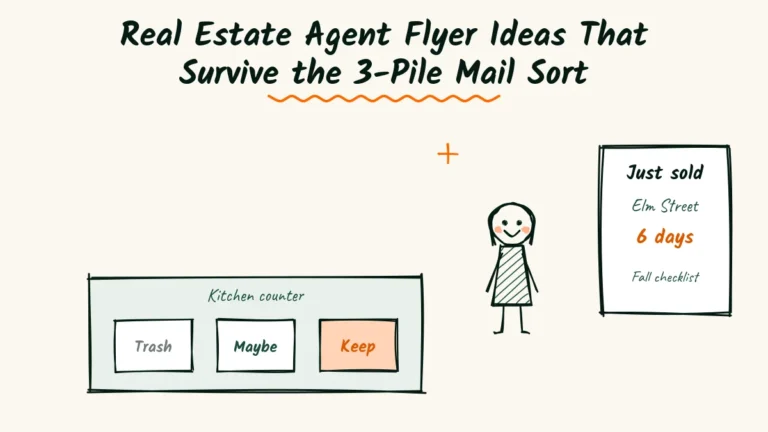

Tuesday’s mail lands on the kitchen counter. A pizza coupon, a car warranty letter, a dentist reminder and you.
In about three seconds, it all gets sorted into three piles. Trash, maybe and keep.
Most real estate agent flyers land in the trash pile before the kettle boils.
They show a smiling headshot, a slogan about dreams and a phone number, and nothing the homeowner actually wants.
The flyers that survive give people something.
A price on their own street, a home they recognize or a little calendar worth sticking on the fridge.
This guide shows how to win each sort, from the one-second trash test to the keep pile.
You’ll get flyer types that work, headlines, a sample, a fill-in template and the rules every agent needs to follow.
Why the sort matters so much
People don’t read mail. They sort it. Most pieces get a glance of a second or two before landing on a pile.
That means your flyer is judged by what shows in that glance. Not by your best paragraph, your awards or your carefully chosen font.
Agents who understand the sort design for it.
They put the one thing a homeowner cares about right at the top, where the eye lands first.
Think about how you sort your own mail.
You probably keep the dentist reminder and the school calendar, and toss anything that looks like it wants something from you.
It also means consistency pays.
A homeowner who sorts your flyer into maybe this month might move it to keep next month, if it keeps being useful.

Who sorts your mail?
The homeowners on your list aren’t all thinking about moving. Most aren’t. Your flyer has to be worth a glance even for them.
| Homeowner | What they care about | What earns a keep |
|---|---|---|
| Long-time owner | What the home is worth | Recent prices on their street |
| Thinking of selling | Timing, prep, price | A simple seller checklist |
| Renter nearby | Whether buying is possible | A plain first-step guide |
| New neighbor | Getting settled | Local events and services |
Write each flyer for one of these people. A flyer that tries to talk to all four ends up talking to none.
Most agents get the most value from the long-time owner.
They may not move this year, but when they do, they’ll call the agent who’s been useful all along.

A real estate agent flyer that survives the sort
Each pile has its own test. A good flyer passes all three in order.
Here’s what each sort is really checking.

Pass the trash test in one second
The trash test is brutal. In one second, the homeowner asks whether this has anything to do with them.
Put their street, their neighborhood or a home they know at the top.
“A home on Elm Street sold in 6 days” passes. “Your dream home awaits” fails.
A photo of a recognizable local house or street works better than your headshot here. People notice places they know.
Pass the maybe test in five seconds
If the flyer survives one second, the homeowner gives it a few more. Now they want a useful fact.
A price, a number of days on the market or a short trend.
“Homes on your street sold for about 4 percent more than last spring.” Make sure every number is accurate and comes from real local sales.
One clear fact beats a table of ten. You want them curious, not overwhelmed.
Pass the keep test for the fridge
The keep pile is the prize. Here, the flyer must be useful beyond today.
Add something people want to keep.
A seasonal home maintenance checklist, a calendar of local events or a list of trusted local services.
Your name and number sit quietly at the bottom.
Every time they look at that checklist, they see your name. That’s how a flyer becomes a relationship.
Pick the right kind of flyer
Agents use a few classic flyer types. Each has a different job, and each needs its own focus.
| Flyer type | Job | What to lead with |
|---|---|---|
| Just sold | Show proof nearby | The street and how fast it sold |
| Just listed | Invite neighbors to look | The home and the open house date |
| Open house | Bring people through the door | Date, time and one standout feature |
| Market update | Show you know the area | One or two local numbers |
| Seller guide | Start a conversation | A short checklist |
You don’t need all five at once. Pick one or two that fit your goals this season, and do them well.
A newer agent might start with market updates and a seller guide.
An agent with active listings gets the most from just-listed and open house flyers on the streets around them.

Write headlines about places, not dreams
Real estate headlines love big feelings.
“Find your forever home.” “Live the life you deserve.” They sound nice and say nothing about the street.
Place-based headlines work better on a flyer.
- Just sold on Elm Street, in 6 days.
- What’s your Oak Hill home worth this spring?
- Open house Sunday, 2 to 4, on Cedar Lane.
- Three homes on your street changed hands this year.
- New to the neighborhood? Here’s what’s happening this month.
Each one names a place the reader knows. That one detail turns a generic ad into neighborhood news.

Use numbers carefully and honestly
Numbers make flyers interesting. They also carry a responsibility.
Only share numbers you can back up with real local sales data.
Round them sensibly, and say the time frame. “Median sale price in Oak Hill, last six months.”
Never claim credit for a sale you didn’t make.
If you share a sale handled by another agent, say “sold in your neighborhood,” not “sold by me.”
Many states and brokerages have rules about this, and it’s simply honest.
Write down where each number came from before you print.
If a homeowner asks, you can explain it in a sentence, and that answer builds more trust than the number itself.
Avoid predictions.
“Prices will rise 10 percent next year” is a promise you can’t keep. “Here’s what happened last season” is information people trust.
Follow the advertising rules
Real estate flyers are advertising, and advertising comes with rules. Most are simple once you know them.
Name your brokerage
Most states require your brokerage name on any ad. Some also want your license number.
Check with your broker and follow their template.
Keep fair housing in mind
Describe homes and places, not the people who should live there. “Three bedrooms near the park” is fine.
Phrases about ideal families or types of people are not.
Honor do-not-mail requests
If someone asks you to stop sending flyers, remove them from your list right away. A polite agent is remembered.
A pushy one is remembered too, in a different way.

Help first-time buyers too
Renters near your farm area are tomorrow’s buyers. A simple, friendly flyer can start that relationship early.
Offer a plain first-step guide. What credit score lenders often look for, what a down payment really means and how pre-approval works.
Point them to neutral help as well.
The Consumer Financial Protection Bureau has a free guide for buying a home that explains each step clearly.
Keep the tone encouraging. Many renters assume buying is out of reach, and a kind, practical flyer can show them the first small step.
You might host a free first-time buyer evening at the library and promote it with the flyer.
People who come are often a year or two from buying, which is exactly when a helpful agent becomes their agent.
Sharing a trusted outside source shows you care about the buyer, not just the sale.
That’s exactly the kind of agent people remember when they’re ready.
Give homeowners an easy way to reply
A flyer that makes people curious needs an easy next step. For many homeowners, a text feels easier than a phone call.
Offer a simple text option. “Text OAKHILL to get your free home estimate.” It’s quick, private and low pressure.
When someone texts, reply warmly and quickly.
Confirm what they asked for and say when they’ll get it.
Then ask one easy question, like whether they’d like a quick visit or just the numbers.
Never pressure people who reply. Many are only curious, and that’s fine.
Curious homeowners often become sellers a year or two later, if you treat them kindly now.

Leave these off your flyer
Some things look normal on agent flyers but quietly push them into the trash pile.
Skip the giant headshot that takes up half the page. Skip lists of awards and sales volume.
Skip phrases like “top producer” or “number one agent” unless you can prove them, and even then, they rarely help.
Skip guarantees about price or selling time. Every home is different, and promises like that can cause real trouble.
Skip tiny print packed with conditions. If an offer needs a paragraph of explanation, it’s not a flyer offer.
Design for a quick glance
You don’t need a designer for a good flyer. A few choices make most of the difference.
Use one large photo of a real local home or street. Keep the headline big and short.
Use dark text on a light background, with one accent color from your brand.
Put your name, brokerage and phone number together at the bottom, in a clear size. Don’t make people hunt for how to reach you.
Leave space. A flyer with breathing room looks confident and is easier to read at a glance.
Print on sturdy card stock. Thin paper bends in the mailbox and feels cheap in the hand, while a firm postcard feels worth keeping.

Write a just-sold flyer neighbors don’t mind
Just-sold flyers are the most common real estate mail, and many feel like bragging. A small shift in tone makes them welcome instead.
Frame the sale as neighborhood news. “A home on Elm Street just sold.
Here’s what that means for your street.” Then share one helpful fact, like how many days it took or how prices compare with last year.
Add a short thank-you to the neighbors for their patience during showings, if you were the listing agent.
People notice when an agent remembers that open houses bring cars and strangers to their street.
Keep your own name modest. The street is the star. You’re the helpful neighbor who knows what happened there.
If you didn’t handle the sale, you can still share the news.
Just say clearly that it sold in the neighborhood, so nobody thinks you’re taking credit for another agent’s work.
Make open house flyers easy to act on
Open house flyers have one job. Get people through the door on a specific day.
Put the date and time first, large and clear.
“Open house Sunday, 2 to 4.” Then the address and one standout feature, like a big backyard or a renovated kitchen.
Invite the neighbors directly. Many will come out of curiosity, and some are quietly thinking about selling.
A line like “Neighbors welcome, come see what’s changed inside” works well.
Hand these out a few days ahead, not weeks. Too early and people forget. Too late and their Sunday is already planned.
At the open house, have a second flyer ready.
A short seller checklist or a market snapshot gives curious neighbors something to take home.

Partner with local businesses
The keep pile loves useful local information. Local businesses can help you provide it.
Ask a few favorite shops, cafes or service companies if they’d like a small mention on your seasonal flyer.
A bakery’s holiday hours, a hardware store’s fall workshop or a landscaper’s spring tips.
The homeowner gets useful local news. The business gets a little attention. You become the person who connects the neighborhood.
Keep partners few and genuinely helpful. A flyer stuffed with ads stops being useful and starts feeling like a coupon book.
Read a sample flyer
Here’s how the three sorts look on one postcard for Harriet, an agent in Abilene, Texas, who farms a neighborhood called Oak Hill.
Just sold on Elm Street, in 6 days.
Homes in Oak Hill sold for a median of $248,000 over the last six months.
On the back, your fall home checklist, five small jobs before the first cold snap.
Curious what your home might sell for? Text Harriet at 325-555-0119 for a free, no-pressure estimate.
[Brokerage name and license number]
The front passes the trash test with a street name. The number passes the maybe test.
The checklist on the back earns a spot on the fridge.

Fill in your own
Use this template for any flyer type. Keep each line to one sentence.
[A headline that names a street, neighborhood or home.]
[One accurate, useful local fact.]
[Something worth keeping, like a checklist or calendar.]
[One easy next step and how to reach you.]
[Brokerage name and license details.]
Write three or four versions over the year, one per season. Keep the layout the same, so homeowners start to recognize you.
The real estate agent introduction video guide pairs nicely with this.
Add a QR code that leads to your short video, so homeowners can meet you before they call.
Swap agent words for homeowner words
Agents use a lot of industry shorthand. Homeowners don’t. Plain words make your flyer easier to read and easier to trust.
| Agent words | Homeowner words |
|---|---|
| CMA | A free estimate of your home’s value |
| DOM | Days it took to sell |
| Inventory | Homes for sale right now |
| Under contract | Sold, waiting to close |
| Comps | Similar homes nearby |
If you use an industry term, explain it in a few words right beside it.

Stay consistent over a whole year
One flyer rarely brings a listing. A steady rhythm usually does.
Many agents mail the same neighborhood once a month or every other month.
The homeowner starts to recognize the layout, the photo and the name.
Vary the content while keeping the look.
A spring market update, a summer event calendar, a fall checklist and a winter year-in-review.
By the time someone decides to sell, you’ve been their neighborhood agent for a year. That’s a very warm first call.
Set a simple calendar for the whole year at the start.
When each month’s flyer is planned ahead, it’s much easier to keep going on busy weeks.
The interior designer flyer guide has more ideas on keeping one look across many pieces.
Test it at the kitchen counter
Before you print, test your flyer the way it will be read. Mix it into a pile of real mail and hand the pile to a friend.
Watch the sort
Ask them to sort the pile the way they usually would. Don’t say which piece is yours.
If your flyer goes in the trash, the top line isn’t doing its job. Change the headline or the photo and try again.
Ask what they remember
After the sort, ask what they remember about your flyer. If they can name the street or the fact, you’ve passed.
If they only remember your face, the flyer is about you, not about them. Shift the focus back to their home.

Track what each flyer brings
Flyers can feel like a guess. A little tracking turns them into something you can improve.
Use a unique link or code
Give each mailing a different QR code or short web address. “Text OAKHILL for your estimate” works too.
After a few months, you’ll see which flyer types and neighborhoods bring the most replies.
Ask every new contact
When someone calls, ask what made them reach out. Was it the price fact, the checklist or a home that sold nearby?
Their answers tell you what to keep and what to drop next season.
Over a year, those small notes add up to a clear picture of what your neighborhood actually wants from you.
Refresh your neighborhood list
Your mailing list changes as people move in and out. A tidy list saves money and avoids awkward mistakes.
Update after every sale
When a home sells, update the owner’s name and send a short welcome flyer to the new neighbors.
A friendly welcome note from the local agent is a lovely first impression.
Remove opt-outs right away
Keep a simple record of anyone who asked not to be mailed. Check it before every mailing.
Respecting that request is good manners, and it protects your reputation in the neighborhood. Word travels fast on a small street.
Point the flyer to one neighborhood page on your real estate agent website, not to a page of listings.
Make the keep pile
A real estate agent flyer wins when it makes the keep pile.
Pass the one-second trash test with a place people know.
Pass the five-second maybe test with an honest fact, and the keep test with something useful for the fridge.
The chance is real. Many agents still mail glossy headshots and slogans, so a useful, local flyer stands out quickly.
The risk is growing.
Online home-value tools reach homeowners instantly, and careless numbers or wording can break trust and rules alike.
Useful, honest mail is how a local agent stays welcome.
So this week, pick one neighborhood and write one useful flyer.
Add a real local fact and a checklist worth keeping, then test it in a pile of real mail before you send it.
Frequently Asked Questions
How often should I mail flyers to one neighborhood?
Many agents mail monthly or every other month. Consistency matters more than volume, so pick a rhythm you can keep.
Should my headshot be on every flyer?
A small photo near your name helps people recognize you. Keep it smaller than the local photo or headline.
Can I mention homes sold by other agents?
Yes, as neighborhood sales, not as yours. Always make it clear who handled the sale, and follow your broker’s rules.
Are door hangers better than mailed postcards?
Both can work. Door hangers suit open houses nearby, while postcards reach a whole neighborhood steadily.
What size postcard works best?
Many agents use about 6 by 9 inches. It’s large enough for a local photo and still easy to sort.

Read next
What to Put on a Product Photographer Flyer, From Sticker to Booth Sign (6 Sizes)
Online sellers still meet you in person. Write six print pieces, from a parcel sticker to a booth sign, that all say one thing.
Read NowWhat to Put on a Plumber Flyer, Built Like a Pipe in 4 Parts
Build your flyer like a pipe, four parts from headline to phone number, so it stays in the drawer until the day a pipe bursts.
Read NowMath Tutor Flyer Ideas, Solved Like a Word Problem in 5 Steps
Build your tutoring flyer like a word problem, five steps parents follow in seconds, plus a tiny puzzle kids stop to solve.
Read Now