
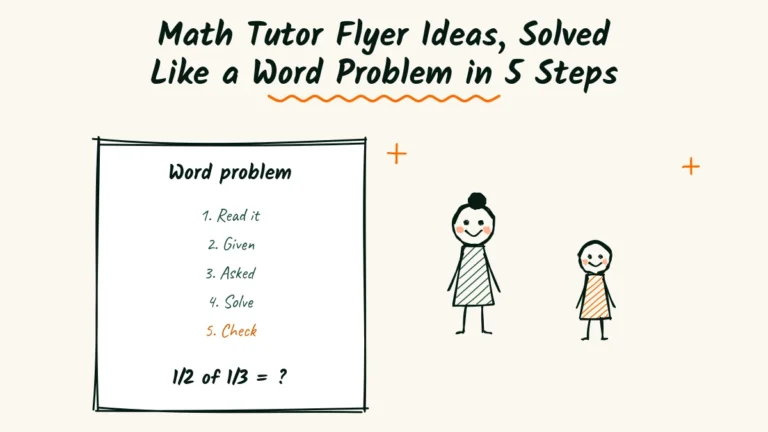

A parent walks past 30 flyers between the school gate and the library desk. She has about eight seconds and one worried kid.
How many flyers does she actually read? Show your work.
The honest answer is one, maybe two. A math tutor flyer only works if it’s one of them, and most aren’t.
They say “All subjects, all ages” in tiny letters, show a clip-art pencil and hide the phone number at the bottom.
This guide solves the problem the way you’d teach a word problem.
Read it, underline what’s given, find what’s asked, solve it and check the answer.
Along the way you’ll get headlines by grade, a sample flyer and a fill-in template.
There’s also a small puzzle trick that makes kids grab your flyer first.
Two people read every tutoring flyer
A tutoring flyer has two readers, and they want different things. The parent pays.
The kid decides whether the first session goes well.
Write for both, but write to the parent first. They’re the one who will read the details, check the price and make the call.
| Reader | What they worry about | What they need to see |
|---|---|---|
| Parent | Falling behind, cost, safety | Grades you teach, price, where sessions happen |
| Kid | Feeling slow, a strict adult | A friendly face, a hint of fun |
The parent reads for proof and practical details. The kid glances for a clue about whether you’re nice.

A flyer that only speaks to parents feels like homework. One that only speaks to kids doesn’t get the phone call.
You need a little of both.
Where tutoring flyers get noticed
Placement matters as much as wording. A great flyer in the wrong place is just paper.
| Place | Why it works | Ask first? |
|---|---|---|
| Public library board | Parents and students visit weekly | Usually yes |
| Community center | After-school programs nearby | Yes |
| Coffee shop near a school | Parents wait there at pickup | Yes |
| Apartment lobby | Families with kids, close by | Ask the manager |
| Pediatric or dental office | Parents sit and wait | Ask the front desk |
Schools themselves often have strict rules about outside flyers.
Ask the office or the parent group before posting anything on school grounds.

The best spots are places parents wait. A flyer read during a ten-minute wait gets more attention than one passed at a run.
Think about your own town for a minute. Where do parents sit with nothing to do?
Swim lessons, dance studios, piano teachers’ waiting rooms and barbershops on Saturday mornings all fit.
Those quiet minutes are when a parent finally reads the whole flyer instead of skimming the headline.
A math tutor flyer in 5 steps
You already teach students to break a word problem into steps. Your flyer can be built the same way.
Each step answers one question before the reader moves on.

Step 1. Read the problem
Start by naming the problem the parent already feels. “Fractions turning homework into tears?” or “Algebra suddenly not making sense?”
This is your headline. It should sound like something a parent has said out loud at the kitchen table.
General headlines like “Math Tutoring Available” describe you, not the problem. A parent walking past doesn’t stop for a description.
They stop when they recognize their own evening.
Step 2. Underline what’s given
Next, give the facts parents need to know right away. Which grades, which subjects and where sessions happen.
“Grades 4 to 8. Math only. At the library or online.” Three short facts beat a paragraph.
Step 3. Find what’s asked
Parents are really asking one thing. Will my kid feel better about math?
Answer it with a short promise you can keep. “Calm, one-to-one sessions that rebuild confidence one step at a time.”
Avoid promising grades. You can’t control a test, and parents trust tutors who don’t oversell.
The word calm does a lot of work here.
Most parents of struggling students are less worried about a grade.
They worry about the tears, the arguments and the slammed books at homework time.
Step 4. Solve it
Now give the next step. A free 15-minute call, a first session at a lower price or a short quiz to see where the student is.
Make the phone number or QR code big enough to read from a few steps away.
Say what happens when they call.
“A quick chat about where your child is stuck, then we pick a time.” Knowing the next step makes the call feel small and safe.
Step 5. Check your answer
The last line adds proof. A short quote from a parent, with permission, or a plain fact about your experience.
“Taught middle school math for 9 years” is enough. So is “My son stopped dreading Tuesdays.”
One strong line beats a list of five.
Parents skim proof the same way they skim headlines, looking for the one sentence that feels true.
Choose a photo that says calm
Your photo does more work than any line of text. Parents and kids both look at it before they read a word.
Pick a photo where you look relaxed and friendly. Natural light, a real smile and maybe a whiteboard or a notebook in the frame.
Avoid the stiff headshot with crossed arms.
It might look professional, but to a nervous ten-year-old it looks like the principal’s office.
If you’d rather not show your face, show your hands writing out a problem step by step.
It still feels human, and it shows how you teach.
Whatever you choose, use the same photo on your flyer, your website and your Google profile.
Parents who look you up should recognize you instantly.

Headlines for every grade
Parents of a third grader and parents of a junior worry about different things.
If you print versions for different ages, match the headline.
- Elementary. “Times tables still a struggle?” “Make math feel like a game again.”
- Middle school. “Fractions turning into tears?” “Ready for pre-algebra, without the panic.”
- High school. “Algebra stopped making sense?” “Geometry proofs, explained calmly.”
- Test prep. “Math section of the SAT or ACT coming up?” “Steady practice, not last-minute cramming.”
- Summer. “Keep math fresh over the summer break.”
Pick one headline per flyer. A flyer that tries to speak to every grade ends up speaking to none.
If you tutor many ages, print two or three versions and post the right one in the right place.
The middle school version belongs near the middle school, and the test prep version near the high school library.

Add a tiny puzzle
Here’s a trick most tutors never try. Put one small, friendly math puzzle on your flyer.
“Which is bigger, half of a third or a third of a half?” Kids stop to think. Parents notice their kid stopping.
Put the answer on your website, behind a QR code, or say “Ask me for the answer.” Either way, the puzzle starts a conversation.
Keep it easy enough to feel fun, not like a test. The goal is curiosity, not a grade.

Change the puzzle each season. Families who saw last month’s flyer will look again just to see the new one.
Keep one look on every flyer
You’ll probably print several versions for different grades and seasons. Keep the look the same across all of them.
Use the same colors, the same photo and the same layout. Only the headline and the puzzle should change.
When parents see your flyer in three places, they start to recognize it.
Recognition turns into trust, and trust turns into a phone call.
Pick colors that are easy to read.
Dark text on a light background works best on busy boards, where bright neon often fades into the noise around it.
Say the price, plainly
Tutoring prices vary a lot, and parents often guess high. A clear price line helps the right families call.
You don’t need a full price list. One line is enough.
- From $45 a session, 60 minutes.
- First session half price.
- Packages of 8 sessions for regular students.
If you offer a sliding scale or a few lower-cost spots, mention it gently. Some families need that line to feel they can ask.
Keep the price line short and near the phone number.
Parents who like what they read look for the cost next, and they shouldn’t have to hunt for it.
Show real results, honestly
Parents want to know tutoring works. They also distrust big promises.
Share progress in plain words.
“Most students move from guessing to explaining their steps within six weeks.” Base it on your own experience, and keep it modest.
National math results have been a worry for many families in recent years, and the Nation’s Report Card tracks those trends.
You don’t need to quote numbers on a flyer. Just know why many parents are paying closer attention.
Never promise a specific grade or score. “Guaranteed A” sounds good and breaks trust the first time it doesn’t happen.
Protect students’ privacy
Tutors work with kids, so privacy matters more than in most businesses.
No student names or faces without permission
Don’t use a student’s photo, name or work on a flyer unless a parent gives written permission. Even then, first names only.
A photo of you at a whiteboard, or your hands working through a problem, works just as well.
Keep contact details for parents
Make it clear that parents book sessions, not kids. “Parents, call or text” is a simple, reassuring line.

Write two lines just for the kid
Most tutoring flyers forget the student entirely. Yet kids often see the flyer first, standing next to a parent at the library.
Add two short lines aimed at them. Keep them light and kind, never babyish.
“Math doesn’t have to feel scary.
We’ll go one step at a time, and mistakes are welcome.” A line like that tells a nervous kid this tutor won’t make them feel slow.
Place it near your photo. Kids look at faces first, then read the words closest to them.
If you work with teenagers, drop the cute tone entirely.
A simple “No judgment, just steady practice” respects them more than cartoons or emojis ever will.
Give parents a reason to keep it
A flyer that gets read once and thrown away is a missed chance.
Give parents something useful, so it stays on the counter or in a folder.
The back of your flyer is the perfect spot.
Add a short checklist of skills for one grade, like “By the end of 5th grade, most kids can add fractions with unlike denominators.”
Parents love a quick way to check where their child stands. They’ll keep the flyer, and your phone number stays with it.
You could also add three tiny tips for homework time.
Short sessions, a quiet table and asking the child to explain the steps out loud.
The tips cost you nothing to share. They show parents how you think, which is exactly what they’re trying to judge.

Partner with people parents already trust
Some of the best flyer spots come from people, not boards.
Librarians, coaches, after-school staff and pediatric receptionists all hear parents worry about math.
Introduce yourself in person and leave a small stack of flyers. Ask if they’d mind passing one along when the topic comes up.
A recommendation from a librarian carries far more weight than a flyer alone.
The flyer simply makes the recommendation easy to act on.
Thank these people properly. A handwritten note at the end of term goes a long way, and it keeps your name in mind for next year.
Be careful not to pay for referrals in ways that feel uncomfortable or break workplace rules. A thank-you card is almost always fine.
Cash usually isn’t.
Make the first step feel safe
Many parents hesitate before calling a stranger to tutor their child. Your flyer can lower that hurdle.
Offer a short, free phone chat before any session.
Say that parents are welcome to sit in on the first lesson, or that online sessions can be recorded for them to watch.
These small promises tell parents you have nothing to hide. They often matter more than your qualifications.
If you meet students in person, say where. A public library or a community center feels safer to many families than a private home.

Read a sample flyer
Here’s how all five steps look on one flyer, for Ms. Delacroix, a math tutor in Bethlehem, Pennsylvania.
Fractions turning homework into tears?
Grades 4 to 8. Math only. At the library or online.
Calm, one-to-one sessions that rebuild confidence one step at a time.
Taught middle school math for 9 years.
First session half price. Parents, call or text 610-555-0187.
She adds a puzzle in the corner and a small photo of herself smiling at a whiteboard. That’s the whole flyer.

Fill in your own
Use this template, one line per step.
[A problem parents say out loud.]
[Grades, subjects and where sessions happen.]
[A calm promise you can keep.]
[One line of proof.]
[First step and a parent phone number.]
Read it to a parent you know. If they can repeat the grades and the next step, it works.
The math tutor introduction video guide pairs well with your flyer.
Add a QR code that leads to the video, so parents can see you teach before they call.
Swap teacher words for parent words
Teachers use words that parents don’t always know. On a flyer, plain words win every time.
| Teacher words | Parent words |
|---|---|
| Differentiated instruction | Lessons that fit your kid |
| Number sense | Feeling comfortable with numbers |
| Remediation | Catching up, calmly |
| Enrichment | Extra challenge for kids who love math |
| Formative assessment | Quick checks to see what’s clicking |
Use your expertise to choose the plain word, not to show off the technical one.
You can bring in the proper terms during sessions, once trust is built.
On a flyer, the goal is simply to be understood in a few seconds by a busy parent.

Post at the right time of year
Tutoring demand follows the school calendar. So should your flyers.
Late August and early September bring back-to-school worries. Report card weeks in November and February bring sudden calls.
Spring brings state tests and end-of-year finals.
In summer, focus on keeping skills fresh. Many parents worry about kids forgetting math over the break.
Plan the flyers a couple of weeks early. Parents start worrying before report cards arrive, not after.
Print small batches for each season, and swap the headline to match. Old flyers about back to school look stale by December.
The product photographer flyer guide shows another way to keep one message across different sizes and seasons.
Test it on a parent and a kid
Before you print, show your flyer to a parent and a child you know. Their reactions will tell you more than any design rule.
What to ask the parent
After five seconds, take the flyer back. Ask what grades you teach and how they’d reach you.
If they can’t say, make those lines bigger and clearer.
What to ask the kid
Ask if you look nice. Ask if they tried the puzzle. Kids are blunt, and that’s exactly what you need.
Their first reaction is usually the honest one.
If they say you look strict, change the photo.

Track which flyers bring calls
You’ll post flyers in several places. Knowing which ones work saves time and paper.
Use a different code or link
Give each location its own QR code or a short code to mention.
“Mention LIB10 for 10 percent off” for the library, “Mention CAFE10” for the coffee shop.
After a month, you’ll know which spots are worth refreshing.
You may be surprised.
Tutors often find that one quiet coffee shop beats a busy library board, simply because parents sit there longer.
Ask every parent
On the first call, ask how they found you. Write it down. A simple list in a notebook is enough to spot patterns.
Refresh your flyers often
Tutoring flyers fade fast, both in the sun and in people’s attention.
Replace them monthly
Visit your spots once a month. Swap faded flyers for fresh ones, and change the puzzle.
A fresh flyer tells parents you’re active and available.
Take a photo of each board when you visit. Over time, you’ll see which spots stay tidy and which ones bury every flyer within a week.
Update the details
Check your grades, prices and availability each term.
If your schedule is full, say “Waitlist open for January.” It still builds interest.
The QR code on your flyer should open a math tutor website page with prices and a short booking form.
Carry the one
A math tutor flyer is a small word problem with a clear answer.
Name the problem, give the facts, make a calm promise, show the next step and add a little proof.
The chance is real.
Most tutoring flyers still say “all subjects, all ages” in tiny print, so a clear, friendly one stands out on any board.
The pressure is real too. Big online tutoring companies and homework apps reach parents cheaply.
A flyer that looks generic loses to them on price.
Small, steady flyers in the right places are how a local tutor stays visible.
So this week, write one flyer for one grade band.
Add a puzzle, post it in two places where parents wait and ask every caller how they found you.
Frequently Asked Questions
Can I put flyers on cars in a school parking lot?
Usually not. Most schools forbid it, and parents find it annoying. Stick to approved boards and places that welcome flyers.
Should my flyer mention online tutoring?
Yes, if you offer it. Many families prefer online sessions in winter or when schedules get busy.
Do I need a business name on my flyer?
Not necessarily. Your own name and photo often build more trust for a solo tutor than a company name.
What size flyer works best for tutoring?
A half-page flyer fits most boards well. Full pages can work in libraries with plenty of space.
Should I list my teaching certificate?
Yes, if you have one. A short line like certified math teacher reassures parents quickly.

Read next
What to Put on a Product Photographer Flyer, From Sticker to Booth Sign (6 Sizes)
Online sellers still meet you in person. Write six print pieces, from a parcel sticker to a booth sign, that all say one thing.
Read NowWhat to Put on a Plumber Flyer, Built Like a Pipe in 4 Parts
Build your flyer like a pipe, four parts from headline to phone number, so it stays in the drawer until the day a pipe bursts.
Read NowPersonal Trainer Flyer Ideas Read From 3 Distances, 10 Feet to Your Table
Design your fitness flyer for three distances, from a glance across the room to the kitchen table, so beginners call you first.
Read Now