

“So, what do you do?”
“I photograph products.”
“Oh. Like for catalogs?”
That little pause at a craft fair table says a lot.
People don’t picture what a product photographer does, so they fill the gap with the wrong idea.
A product photographer flyer, card or sign has one job before anything else. It answers that question before you have to.
A big print budget isn’t required.
What matters is the right words at the right size, in the places where online sellers actually stand still for a moment.
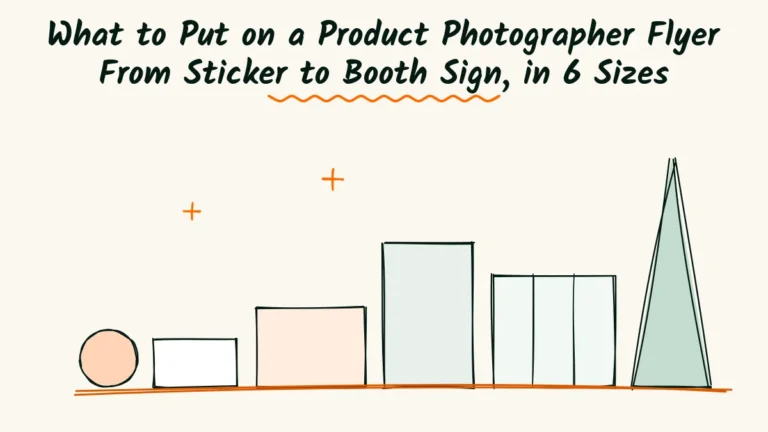
So instead of one flyer, think of six pieces of paper, from a sticker to a booth sign. Write the smallest first.
Each bigger size adds just one more thing, so your message stays the same from a parcel to a market stall.

Print still works for a business that lives online
It sounds odd at first. Your clients sell online, so why print anything at all?
Because sellers also go places. They stand at craft fair tables all weekend. They buy wax, jars and labels at supply shops.
They work from co-working spaces and wait in line at the post office with a stack of parcels.
In each of those places, they have a minute with nothing to scroll.
A card on a counter or a sign at a booth can reach them when they’re thinking about their shop, not their phone.
Print also lasts.
A good postcard can sit on a desk for months, quietly reminding a seller that you exist when it’s time to fix their photos.
The rules of good print and signage copy are the same for every small business. Short words, one clear picture and one easy next step.
Where online sellers stand still
Each piece of paper has a home.
Matching the piece to the place keeps you from handing a brochure to someone who only wanted a sticker.
| Place | Best piece |
|---|---|
| Craft fairs and makers markets | Half-page flyer, booth sign |
| Craft and packaging supply shops | Postcards by the till |
| Co-working spaces | Full-page flyer on the board |
| Post office and shipping stores | Business cards, if allowed |
| Client parcels | Sticker and postcard |
| Meetings with growing brands | Trifold brochure |
You don’t need all six at once. Pick the two places you already visit most, and print for those first.
A quick check helps here. Think about the last ten sellers you worked with and where you met them.
That list usually points straight at the right piece.
Start small, then grow the words
Most people write a full flyer first and then try to squeeze it onto a card.
It never fits, and the card ends up cramped and confusing.
Flip it around. Write the smallest piece first, then let each bigger piece add one new part.
| Size | What it adds |
|---|---|
| Sticker | Who you are and one promise |
| Business card | How to reach you |
| Postcard | One before and after |
| Half-page flyer | A price and a reason to act now |
| Trifold brochure | Packages and process |
| Booth sign | One big line people read from afar |
By the time you reach the brochure, the message has been tested five times.
Every piece sounds like the same person, because it grew from the same few words.

The sticker, five words or fewer
A round sticker is the smallest thing you’ll print, and the hardest to write. That’s why it comes first.
It needs your name and one promise. Nothing else fits.
- Photos that sell. Bramble Studio.
- Make your listings shine.
- Your products, photographed properly.
Stick them on the boxes you send back to clients, on your laptop at markets, or on the tissue paper around returned products.
A seller who unpacks their candles and sees your sticker remembers who did the work.
If you can’t decide on a promise, look at the sticker you wrote and ask whether a seller would care.
“Professional photography” doesn’t pass. “Photos that sell” does.
Stickers also work on your own packaging if you sell prints or presets. Anything that leaves your studio can carry your name.

What fits on a business card?
A business card adds one thing to the sticker. How to reach you.
Keep the front for your name, the same promise and one clear line about who you help. Put your contact details on the back.
Front. [Your name]. Product photos for online shops. [The promise from your sticker]
Back. [Website], [email], [phone or Instagram handle]
That’s all. No list of services, no tiny paragraph about your story.
Many photographers print a product photo on the back of their card. It’s a nice touch, but only if it’s one product shown clearly.
A busy collage is hard to read at card size.
Carry a few cards everywhere, not just to events.
Sellers turn up in odd places, like the line at the shipping store or the next table at a cafe, often holding a box of their own products.

Slip a postcard into every box you send back
The postcard is where your print starts to sell. It adds a before and after.
Postcards are handy because they mail cheaply, as long as you keep them within the size limits.
The USPS lists postcard rates for cards between 3.5 by 5 inches and 4.25 by 6 inches, which suits most simple designs.
Use the front for one product shot two ways, phone photo and pro photo, side by side. Use the back for a few short lines.
Same candle. Same afternoon. Very different listing.
I photograph products for online sellers, ready for Etsy, Amazon and your own shop.
Know a maker who needs this? Pass this card on.
That last line matters most. Put one postcard into every box you return to a client.
They know other sellers, and a card in their hand is easy to share.

The product photographer flyer for a craft fair table
Craft fairs and makers markets are full of your ideal clients.
They’re also busy, loud and crowded, so a half-page flyer works better than a full sheet.
It fits in a bag and doesn’t feel like homework.
This size adds a price and a reason to act now.
| Part | What to write |
|---|---|
| Top line | A question sellers already ask |
| Picture | One before and after |
| Middle | Three short facts about what they get |
| Price | A starting price in plain numbers |
| Bottom | One next step with a date |
Here’s how that sounds when it’s filled in.
Do your products look better in person than online?
I photograph products for small online shops. You get 5 photos per product, sized for every marketplace, ready in 7 days.
From $25 a photo.
Book by the end of the month and your first product’s photos are free.
Hand the flyer over with a word or two of real talk. “Do you sell online too?” opens more conversations than any printed headline.

Full-page flyers for shop and library boards
Some places still have community boards.
Craft supply shops, libraries, co-working spaces and cafes near maker studios often welcome local business flyers.
A full page gives you room for one more thing. A short line about who you are, so a stranger feels they know you.
Keep the top half for the picture and the headline.
People read boards from a few steps away, so the biggest words should be readable from across the room.
Put the details in the bottom half. Your price, how to book and a short web address that’s easy to type.
Many photographers add a QR code too, but a clear web address works for everyone, including people whose phones won’t scan.
Always ask before you pin anything up. Shop owners notice who asks, and some will happily recommend you to the makers who shop there.
A trifold brochure for brands that buy in bulk
Most small sellers don’t need a brochure. But growing brands with many products, wholesale buyers or a team of people often do.
They like something they can pass around a table.
The trifold adds your packages and your process. Here’s what each panel can hold, in the order someone opens it.
- Front panel. Your name, your promise and one striking product photo.
- Inside flap. A short note on who you work with, such as candle brands, skincare lines and small food makers.
- Inside left. Your packages, with prices or “from” prices.
- Inside middle. How a shoot works, from shipping the box to receiving the photos.
- Inside right. A few before and afters from real clients, with permission.
- Back panel. Contact details and one clear next step.
Keep each panel to a few short lines. A brochure crammed with text gets folded once and never opened again.
Keep a PDF version of the brochure too.
Brands often ask for something to forward to a partner or a buyer, and a two-page PDF travels far more easily than paper.

The booth sign people read from ten feet away
If you take a table at a makers market yourself, you need a sign.
It’s the biggest piece of paper you’ll print, and it carries the fewest words.
The sign adds nothing new. It shouts the one line from your sticker, big enough to read while walking past.
- “Product photos that sell”
- “Ask me about your listing photos”
- “Free photo tips at this table”
Under the main line, add a large before and after. People slow down for pictures far more than for words.
A plain rule of thumb helps. If you can’t read it from ten steps back, the letters are too small.
Print a test page at home and walk away from it before ordering the big one.
Set the rest of your table to match the sign.
A few real products shown next to their photos, a laptop running a slow slideshow and a small stack of half-page flyers.
Visitors see the promise, the proof and the next step in one glance.

Make every piece easy to act on
A beautiful piece of paper that leaves people unsure what to do is just decoration. Each one needs a single, simple next step.
Pick one action per piece. Visit a short web address, scan a code, send a message or book by a date.
More than one, and people often do none.
Make the address short enough to remember. “bramblestudio.com/fair” is easy to type later.
A long link full of letters and numbers isn’t.
Add a reason to act soon when it’s true. “Book by the 30th” or “Spring spots are almost gone” works, as long as it’s honest.
A deadline that keeps moving teaches people to ignore it.
Time your print to the market calendar
Makers markets follow the seasons, so your print should too. Spring markets bring new sellers trying their luck.
Late summer and fall markets bring sellers preparing for holiday orders.
Print fresh postcards and flyers a few weeks before each season.
Swap the before and after for a seasonal product, like a gift set in fall or a garden item in spring.
Old flyers with last season’s offer look tired fast. A small, timely run always beats a big pile of outdated paper.
Words that work on paper, and words that don’t
Print has less room than a website, so every word has to earn its place. Some words take up space and say nothing.
| Skip | Use instead |
|---|---|
| Professional photography services | Product photos for online shops |
| High quality | Sharp enough to zoom |
| Affordable rates | From $25 a photo |
| Contact us for more information | Book by the 30th |
| Passionate about your brand | Ready in 7 days |
Read your piece out loud before printing.
If a line sounds like every other flyer on the board, swap it for a number, a place or a promise.
The same plain approach works in your product photographer press release ideas too.
Editors and sellers both skim, and both trust specifics.

Keep one look across every piece
Six pieces of paper should look like they came from one studio.
When a seller sees your sticker, then your postcard, then your booth sign, each one should feel familiar.
Pick two colors and one or two fonts, and use them everywhere.
Put your name in the same spot on each piece, usually the bottom or the top corner.
Use the same promise line on all six. Repetition feels boring to you, because you write it.
To a seller who sees it twice in a month, it feels like a name they already know.
That steady look also makes you seem bigger and more settled than you might feel.
Sellers trust a photographer whose paper looks planned.
Pictures on paper behave differently
You know your photos look great on screen. Print can surprise you.
Printers use different inks than screens use light, so bright colors can come out duller on paper.
A vivid blue soap might print a touch gray.
Ask your printer for a single printed proof before you order hundreds. Hold it next to the real product in daylight.
If the colors drift, adjust the file or pick a photo with softer colors.
Choose one strong picture per piece. On a small card, a single product on a clean background beats a busy styled scene every time.
Save the scenes for bigger pieces like the brochure and the booth sign.
Send your printer full-size files, not screenshots or images saved from social media.
Most printers ask for around 300 dots per inch at the printed size.
A photo that looks crisp on a phone can turn soft and blocky on a flyer.

Get it printed without wasting money
Print costs add up fast, especially when you order things you never use. A little care keeps the budget small.
Order small runs first
Start with 50 to 100 of anything new.
You’ll spot mistakes, learn which pieces people take and avoid a box of outdated flyers under your desk.
Ask for a proof every time
A printed proof costs a little and saves a lot. Check the colors, the spelling and the web address before the full run.
Read the web address and phone number out loud, one character at a time. A single wrong digit can waste every copy.
Pick paper that fits the job
Stickers need a weatherproof finish if they’ll travel in parcels. Postcards need card stock thick enough to survive the mail.
Flyers for boards can be lighter, since they don’t travel.
Hand it out like a person, not a bot
Paper only works when it reaches the right hands. How you share it matters as much as what’s on it.
At fairs and markets
Don’t pile flyers on a table and hope. Hand them over during a real chat, ideally after asking about the seller’s shop.
A short question like “Do you sell online too?” turns a stranger into a conversation. Only give a flyer to people who say yes.
At supply shops and co-working spaces
Ask the owner or manager before leaving anything. Offer to come back and refresh the stack each month.
Some will let you leave a small stand of postcards near the till. That’s where makers wait while their wax and jars are rung up.
Inside client parcels
Every box you return to a client is free distribution. A postcard and a sticker cost pennies, and the client already trusts you.
Add a handwritten “thank you” on the postcard now and then. People keep handwritten cards far longer than printed ones.
Track which paper brings work
Print can feel like a guess, but it doesn’t have to be. A little tracking shows what’s worth printing again.
Give each piece its own address
Use a slightly different web address or code for each piece.
For example, yoursite.com/fair for craft fair flyers and yoursite.com/card for postcards.
When someone visits or books through that address, you know which piece did the work. Most website tools can show visits to each page.
Ask every new client
Add one question to your booking form or your first reply. “Where did you hear about me?” Keep a simple tally in a notebook.
After a few months, you’ll see which pieces bring sellers in. Reprint those, and drop the rest.
A seller who found you through a postcard in a friend’s parcel is a sign that piece deserves a bigger run.
The same tally works for online channels too.
Compare it with the messages your product photographer ad copy brings in, and you’ll know where each dollar does the most.

Print the small one first
A product photographer flyer is really six pieces of paper that grow from the same five words.
Start with the sticker, and the rest gets easier.
There’s a real gap to fill.
Most photographers who serve online sellers print nothing at all, so a clear postcard in a parcel or a sign at a makers market stands out.
Sellers meet you in person, then remember you online.
The catch is cost and clutter. Big print runs of vague flyers waste money and end up in recycling bins.
Small runs of plain, specific pieces don’t.
So write your sticker line today. Print 50 postcards with one before and after, and slip one into every box you send back this month.
Then count where your next three clients came from.
Frequently Asked Questions
Can I hand out flyers at a market where I’m not a vendor?
Check the market’s rules first. Many ban selling or handing out flyers unless you have a table, so ask the organizer.
Is it worth paying a designer for my print pieces?
A designer helps with the brochure and booth sign. For stickers, cards and postcards, a simple online template is often enough.
How many flyers should I bring to a craft fair?
Start with about 50 half-page flyers for a one-day fair. You’ll learn how many go, then adjust next time.
What paper size works best for a half-page flyer in the US?
Half of a standard letter sheet, 5.5 by 8.5 inches, is common, cheap to print and fits easily in a tote bag.
Should I give out flyers at my own clients’ market stalls?
Ask first. Some clients are happy to keep a few postcards on their table, and some prefer to keep their stall about their own products.

Read next
What to Put on a Plumber Flyer, Built Like a Pipe in 4 Parts
Build your flyer like a pipe, four parts from headline to phone number, so it stays in the drawer until the day a pipe bursts.
Read NowMath Tutor Flyer Ideas, Solved Like a Word Problem in 5 Steps
Build your tutoring flyer like a word problem, five steps parents follow in seconds, plus a tiny puzzle kids stop to solve.
Read NowPersonal Trainer Flyer Ideas Read From 3 Distances, 10 Feet to Your Table
Design your fitness flyer for three distances, from a glance across the room to the kitchen table, so beginners call you first.
Read Now